How a West African kingdom mastered the global economy, engineered an empire across the savanna, and collapsed under the weight of its own success.
In the spring of 1375, the Majorcan cartographer Abraham Cresques finished the Catalan Atlas—a sweeping depiction of the medieval world that remains one of the defining visual documents of the European Middle Ages. Resting prominently in the middle of the West African interior was the drawn figure of a sovereign seated on an elevated throne, wearing a heavy golden crown, holding a polished scepter in one hand and a gleaming golden nugget in the other. Beside the figure, Cresques penned a simple caption: “This Negro lord is called Musse Mali… so noble and rich is this lord that gold is more abundant in his land than anywhere else.”
For centuries, European and Mediterranean imaginations treated sub-Saharan Africa as a blank, isolated expanse beyond the reach of world commerce. Yet the figure on the Catalan Atlas represented a reality that was already ancient by the time Cresques drew his map. Mansa Musa I of Mali governed a vast, highly integrated imperial network that linked the Niger River valley directly to the global markets of Europe, North Africa, and the Middle East.
Mali was neither a historical accident nor a passive beneficiary of geography. It was a deliberately engineered empire, constructed on institutional flexibility, military logistics, international diplomacy, and strategic economic monopolies. Its rulers solved one of the most difficult challenges of pre-modern statecraft: how to project authority across millions of square kilometers without a standing bureaucratic apparatus in the modern sense. By examining contemporary Arabic manuscripts, archaeological findings along the Niger bend, and Mandinka oral traditions, the story of Mali emerges not merely as a tale of unimaginable wealth, but as an enduring study in the dynamics of imperial expansion and structural decay.
The Manden Awakening
The foundation of Mali was built upon the wreckage of a previous imperial order. For centuries, the Wagadou Empire—known to European and Arab scholars as the Ghana Empire—dominated the northern edge of the West African savanna. Wagadou prospered by positioning itself as the middleman between the Soninke gold miners to the south and the Saharan camel caravans to the north. But by the late eleventh century, internal political fracturing, environmental degradation along the desert fringe, and changing trade routes shattered Wagadou’s central authority.
The collapse created a power vacuum across the upper Niger basin. Out of the political turmoil emerged the Sosso Kingdom, led by the ruler Sumanguru Kanté. Sumanguru expanded aggressively across the Manden region, subjugating local clans, imposing heavy levies of tribute, and dismantling traditional regional autonomous structures. His reign became a turning point, forcing fractured, localized communities into a unified resistance.
That resistance coalesced around Sundiata Keita. According to the oral tradition preserved for centuries by the jalis—the hereditary bards and historians of West Africa—Sundiata was a prince of the Niani clan who spent his youth in exile, building military alliances across neighboring chiefdoms while learning the geopolitical geography of the savanna. Around 1235, Sundiata led a coalition of Mandinka clans against Sumanguru at the Battle of Kirina.
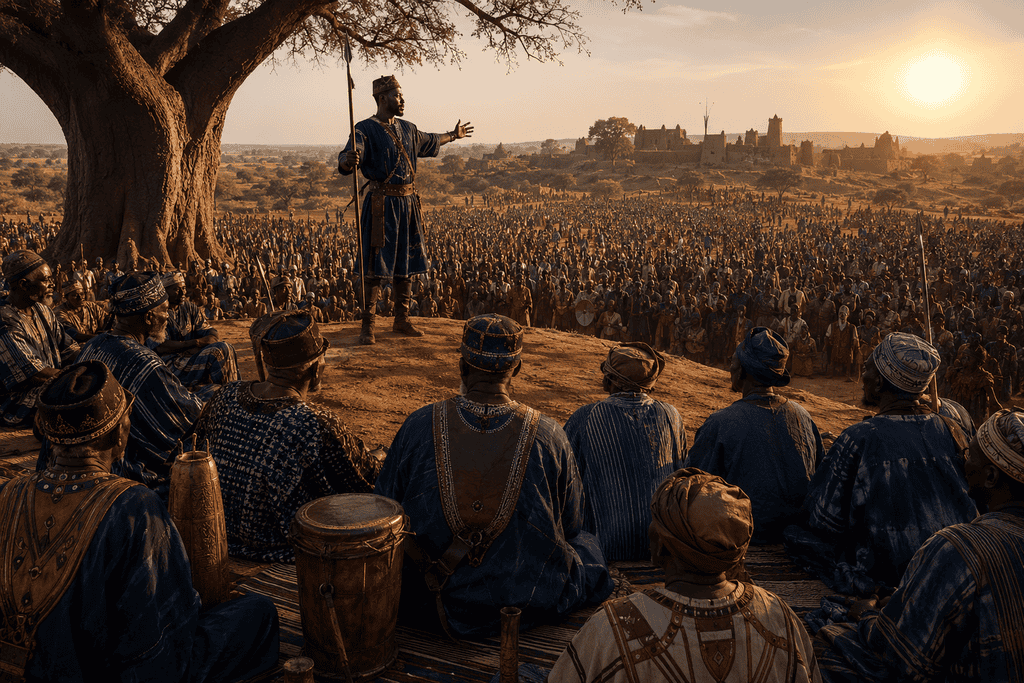
Sundiata’s triumph at Kirina was more than a military victory; it was a institutional revolution. Following the battle, he convened the leaders of the allied clans at Kouroukan Fouga, where he was formally proclaimed Mansa—the “King of Kings.” The assembly codified an oral constitution, the Kouroukan Fouga, which laid down the social and legal structure of the new state. It designated specific roles for warrior clans, organized occupational guilds for blacksmiths, leatherworkers, and bards, established rules for land stewardship, and formed the Gbara—a central council of clan representatives designed to advise the emperor and balance his authority.
Sundiata also made a vital strategic decision: he moved the imperial capital south from the desert edge to Niani, near the upper Sankarani River. This relocation placed the center of power in a fertile agricultural zone capable of supporting a growing population, while positioning the court far closer to the gold-bearing deposits of Buré.
The Zenith of Imperial Power
Sundiata’s early successors systematically expanded the empire along the primary geographic axis of West Africa: the Niger River. The genius of Malian expansion lay in its dual control over two distinct environmental zones. To the south lay the agricultural core of the savanna, which supplied the food required to maintain urban centers and military campaigns. To the north lay the commercial gateways of the Sahel, where southern commodities were exchanged for northern goods.
The empire reached its geopolitical and economic apex under Mansa Musa I, who ruled from approximately 1312 to 1337. Musa inherited a realm that stretched from the Atlantic coast of modern Senegal and Gambia to the bend of the Niger River in modern Niger. Recognizing that Mali’s security depended on its integration into the wider diplomatic world, Musa used religion and statecraft to establish his empire as a major player in the Islamic international order.
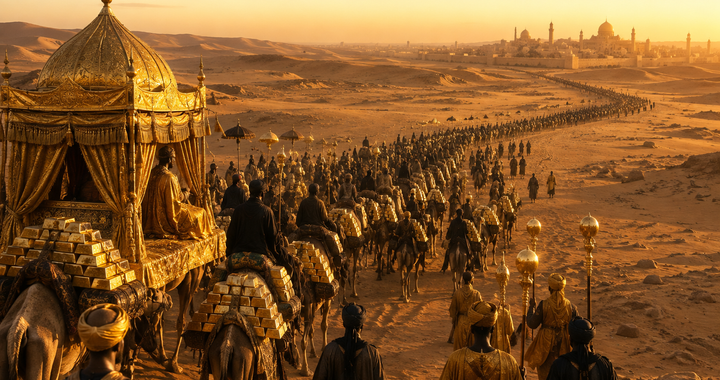
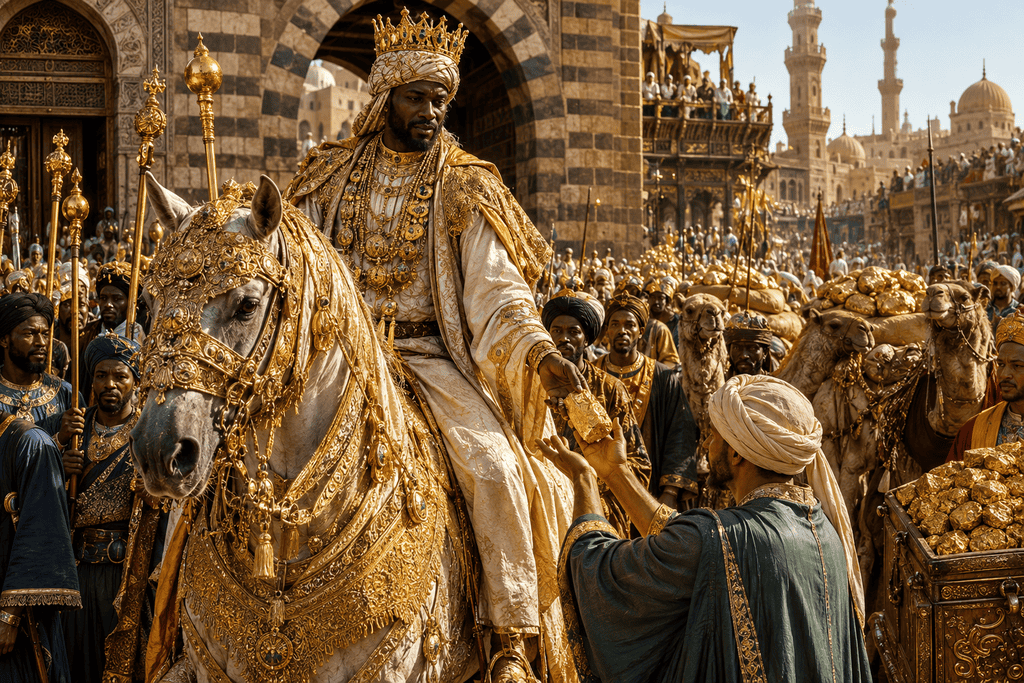
Musa’s defining geopolitical move was his celebrated pilgrimage (hajj) to Mecca in 1324. He traveled across the Sahara with a massive entourage comprising thousands of soldiers, officials, court attendants, and heralds, accompanied by dozens of camels bearing refined gold dust and bullion. When the caravan reached Cairo, Musa’s lavish spending and generous gifts of gold flooded the local economy.
The economic disruption was profound. The sudden influx of hundreds of kilograms of gold so severely devalued the precious metal in Egypt that it depressed the local currency market for over a decade. Writing years later, the Mamluk historian Al-Umari recorded that the price of the gold mithqal in Cairo plummeted and remained depressed for years after Musa’s visit—a rare documented instance of a single individual causing macro-economic inflation across the Mediterranean basin.
Yet Musa’s pilgrimage was far more than an exercise in ostentation. It was a calculated project in soft power. On his return journey, Musa recruited Islamic scholars, legal experts, administrators, and craftsmen from across North Africa and the Middle East. Among them was the Andalusian architect Abu Es Haq es-Sahili, who introduced monumental mud-brick engineering and refined plaster techniques to the Niger River valley.
Under Es-Sahili’s direction, the imperial court built major public structures, including the Djinguereber Mosque in Timbuktu and the royal audience hall at Niani. Timbuktu, which had operated primarily as a seasonal trading encampment, was transformed into an international center of commerce and scholarship. The city’s Sankore district grew into a university complex of madrasas, attracting scholars from across the Muslim world and establishing a manuscript culture in jurisprudence, astronomy, mathematics, and medicine that produced hundreds of thousands of written texts.
The Mechanism of Centralization
The economic engine of the Mali Empire rested on three structural pillars: gold extraction, salt regulation, and agricultural surplus.
Mali did not directly mine all the gold within its territorial borders. Instead, the Mansa exercised strategic control over trade bottlenecks. The primary gold-bearing regions of Bambuk and Buré were worked by autonomous, non-Muslim agrarian communities using alluvial washing and shaft extraction. The imperial court recognized that attempting to occupy these regions directly would cause local resistance and disrupt production. Consequently, the Mansas permitted these communities to retain domestic autonomy while imposing strict state controls on trade.
All raw gold nuggets (tibar) extracted within the empire were legally declared the exclusive property of the Mansa, leaving only gold dust for public market transactions. This central restriction limited internal inflation and allowed the sovereign to manipulate the international export supply. Every caravan transporting gold north toward the Saharan routes was taxed at imperial customs posts located along the Sahelian boundary, such as Walata, Timbuktu, and Gao.
If gold was Mali’s primary export, rock salt was its most critical import. Excavated in massive slabs from the remote Saharan mines of Taghaza, salt was vital for human survival in the tropical savanna, where natural sodium deposits were scarce. When the traveler Ibn Battuta visited Mali in 1352, he observed that houses in Taghaza were constructed entirely from blocks of salt roofed with camel skins, and that the commodity was traded directly against gold dust at imperial customs hubs. By dominating both the northern salt import routes and the southern gold export fields, the Malian state collected taxes on both sides of every transaction.
Supporting this commercial structure was the agricultural productivity of the Niger River Basin. The floodplains yielded regular harvests of sorghum, pearl millet, African rice, fonio, and cotton. Agricultural production was managed through a mix of free peasantry organized in traditional clan units and state-managed farming settlements staffed by labor captured in border conflicts. These state farms provided the reliable food reserves necessary to supply urban populations, regional administrative posts, and military garrisons.
The Dual Legitimacy of Statecraft
A persistent challenge facing Malian statecraft was the ideological divide between the imperial court and the rural populace. To maintain diplomatic and commercial alliances with the Mamluk, Marinid, and Hafsid dynasties of North Africa, the Mansas presented themselves as orthodox Muslim rulers who financed mosques, patronized scholars, and observed Islamic law.
At the same time, the vast majority of the empire’s agricultural and warrior population practiced traditional African spiritual beliefs. The Mansa’s domestic authority depended heavily on his role as the traditional protector of the Manden land.
To bridge this divide, the Mansas developed a system of dual legitimacy. At court in Niani, Islamic scribes recorded state business in Arabic, and Muslim judges presided over commercial and civil disputes in urban centers. Simultaneously, the Mansa retained traditional regalia, participated in ancestral agricultural rituals, and maintained the support of the jalis, who framed imperial authority within the traditional epic lineage of Sundiata.
When Ibn Battuta attended court during the reign of Mansa Sulayman in the mid-fourteenth century, he was unsettled to witness Islamic legal proceedings taking place alongside traditional ceremonies, where masked bards performed ancestral oral poetry before the sovereign. Yet this cultural synthesis was precisely what kept the empire stable. It allowed Mali to participate in international Mediterranean commerce without alienating the rural communities that provided its soldiers and farmers.
The empire’s territorial cohesion was further secured by the Niger River itself. Flowing through the savanna before sweeping north toward the Saharan fringe and then south toward the Atlantic, the Niger functioned as a natural logistical spine. Mali maintained dedicated fleets of river craft operated by specialized riverine communities. These vessels moved royal messengers, agricultural supplies, and military units quickly across vast distances, enabling the imperial center to respond to border incursions long before local uprisings could threaten the state.
The Anatomy of Decline
Despite its institutional strengths, the Mali Empire harbored severe structural vulnerabilities. The most dangerous was its lack of a fixed, uncontested rule of succession.
Unlike political systems governed by strict primogeniture, where the oldest child automatically inherits power, Malian tradition allowed leadership to pass laterally to brothers, down to sons, or to maternal nephews. Whenever a Mansa died without an undisputed successor, the court fractured into rival factional camps. Between 1337 and 1400, the empire was shaken by recurring dynastic disputes, palace coups, and short-lived usurpations.
These internal conflicts destabilized central authority at Niani, encouraging peripheral provinces to break away. The first major rift occurred along the eastern bend of the Niger at Gao. Gao was home to the Songhai people, a seafaring and equestrian culture with a long tradition of autonomy. Captured by Malian forces during the reign of Mansa Musa, Gao gradually reasserted its independence as imperial control weakened in the late fourteenth century.
Under the leadership of Sunni Ali Ber, who came to power in 1464, the emerging Songhai Empire built a fleet of armored river craft and a mobile cavalry force. Sunni Ali turned his military against Mali’s northern possessions, capturing Timbuktu in 1468 and Djenné in 1473. By seizing these cities, Songhai cut Mali off from its northern trade routes, taking control of the trans-Saharan salt and gold exchanges that had financed the Malian state for over two centuries.
As Songhai expanded from the east, Tuareg groups pressed down from the northern desert, seizing Saharan outposts, while Mossi armies raided deep into the southern savanna. Deprived of its tax base and river access, Mali withdrew into its original Mandinka heartland around the upper Niger.
The final structural blow came from an unexpected direction: the Atlantic Ocean. In the mid-fifteenth century, Portuguese mariners established direct sea-based trade routes along the coast of West Africa. For centuries, the wealth of the interior had flowed north across the Sahara through imperial Malian territory. The arrival of European ships reversed this economic orientation.
Gold, ivory, and captive labor began moving directly to coastal ports, bypassing Mali’s inland customs posts entirely. Coastal vassal states, such as the Jolof Empire in modern Senegal, gained direct access to European horses, textiles, and manufactured goods. Able to trade independently, these peripheral territories cast off their tributary ties to Niani.
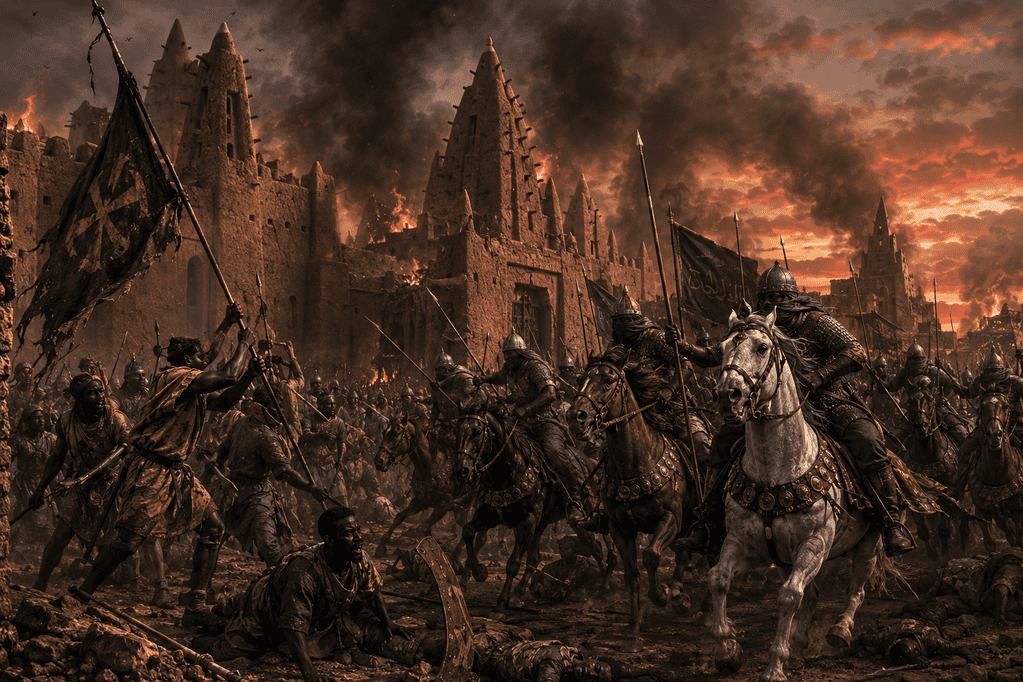
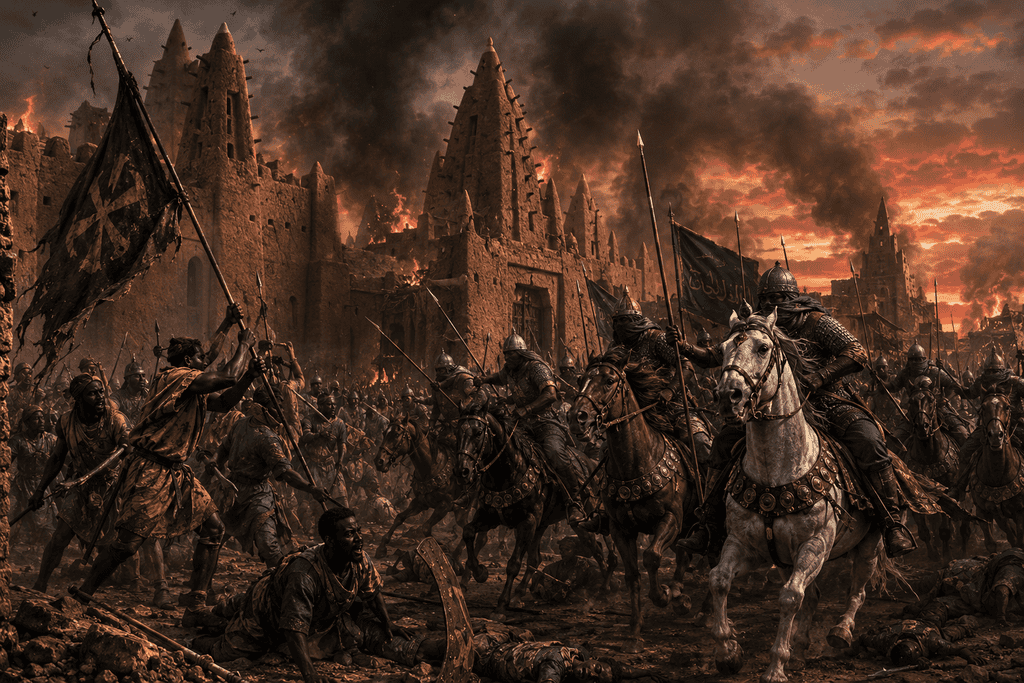
By the sixteenth century, Mali had ceased to function as an empire, returning to its origins as a small, localized principality. The end arrived in 1670, when the rising, non-Muslim Bambara Kingdom of Ségou attacked and burned Niani to the ground. The Keita dynasty dispersed into the countryside, bringing four centuries of imperial Malian history to a definitive close.
Legacy in the Modern World
The Mali Empire left an indelible mark on West Africa that endures in the political, cultural, and social organization of the region today.
The legal and social principles outlined in the Kouroukan Fouga established deep-seated traditions of civic discourse and dispute resolution. Institutionalized social practices, such as sanankuya—a system of cross-clan “joking relationships” that allows different ethnic groups to diffuse conflict through ritualized humor—trace their origin directly to the Mandinka confederation formed under Sundiata. This social mechanism remains a vital tool for maintaining inter-ethnic stability across modern Mali, Guinea, and Senegal.
Intellectually, the academic infrastructure established in Timbuktu and Djenné preserved hundreds of thousands of African manuscripts written in Arabic and local languages using Ajami scripts. These texts, spanning science, philosophy, law, and history, continue to challenge the outdated colonial narrative that sub-Saharan African history relied exclusively on oral culture.
Ultimately, the trajectory of the Mali Empire demonstrates that pre-modern statecraft was far more globally connected, institutional, and complex than traditional European histories long acknowledged. Through clear economic policy, institutional adaptability, and diplomatic vision, Mali constructed a global trading empire that dominated the medieval world—leaving behind lessons in the management of wealth and authority that remain relevant centuries after the burning of Niani.