How early urban societies emerged, organized resources, developed writing, and experimented with new forms of power.
For most of human history, people lived in relatively small, mobile communities, relying on hunting, gathering, fishing, and eventually small-scale cultivation. Then, beginning several thousand years ago, something changed. In different parts of the world, people began settling in increasingly large communities, building monumental structures, managing agricultural surpluses, developing systems of record-keeping, and creating institutions capable of governing thousands of people.
The traditional story is straightforward: agriculture produced surplus food; surplus supported cities; cities required governments; and governments created the first states.
Archaeology tells a more complicated story.
The first civilizations did not emerge according to a single blueprint. Mesopotamia, Egypt, the Indus Valley, the Andes, and early China followed different paths toward urbanization and political organization. Some developed powerful monarchies. Others left little clear evidence of kings or palaces. Some depended heavily on cereal agriculture, while others built complex societies around fishing, trade, and mixed economies.
Civilization, in other words, was not a single destination. It was a series of experiments in how large numbers of people could live together.
The Agricultural Paradox
The foundations of settled life reach back to the Neolithic period, beginning roughly 10,000 BCE in parts of Southwest Asia. Communities domesticated plants such as wheat and barley and animals including sheep, goats, and cattle. Independent domestication later occurred in regions including China, Africa, and the Americas.
Yet agriculture did not immediately produce cities or states.
For thousands of years, farming communities remained relatively small and locally organized. In some respects, early agricultural life could be more demanding than the mobile foraging economies that preceded it. Farming required sustained labor, created dependence on particular crops, and could expose communities to nutritional shortages and disease.
This raises an important question: if agriculture was the foundation of civilization, why did cities and states appear so much later?
One answer lies in the particular characteristics of certain crops and landscapes.
Cereal grains such as wheat, barley, and rice are relatively easy to harvest in large quantities, store, transport, measure, and redistribute. Those qualities made them particularly useful to emerging administrative systems. A ruler or institution that could control grain could also monitor taxes, distribute rations, organize labor, and accumulate reserves.
But agriculture alone was not enough. Geography, population growth, trade, conflict, climate, and social institutions all shaped the transition from villages to cities and from cities to states.
Mesopotamia: The Rise of the Administrative City
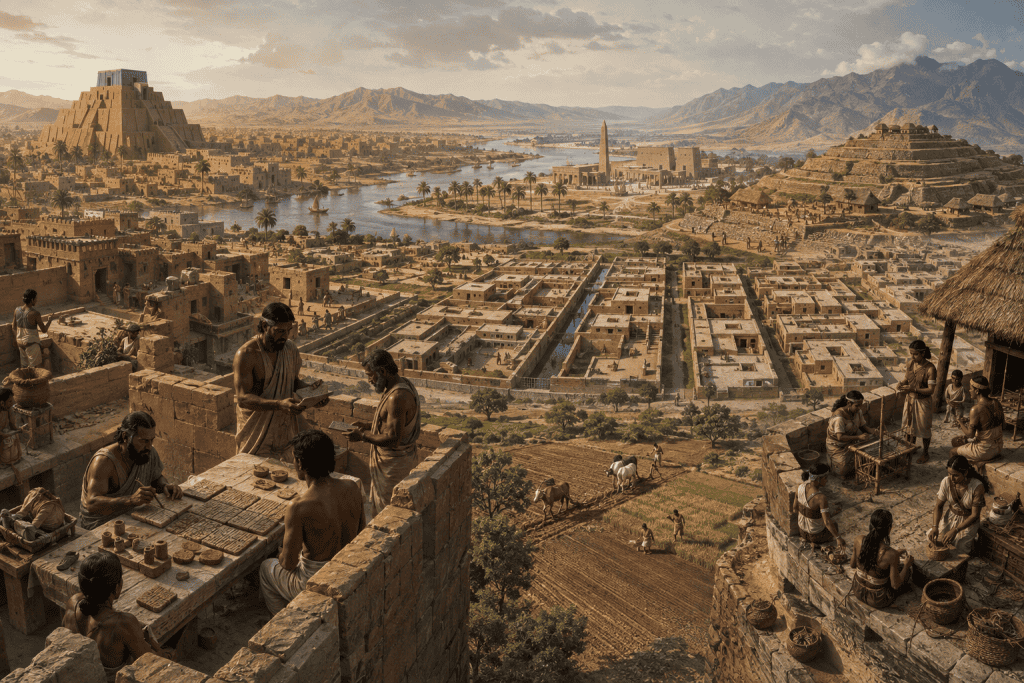
Among the earliest large urban settlements developed in southern Mesopotamia, between the Tigris and Euphrates rivers.
During the Uruk period, roughly 4000–3100 BCE, settlements grew dramatically in size and complexity. Uruk became one of the world’s earliest major cities, with monumental buildings, specialized crafts, long-distance trade, and increasingly sophisticated systems of administration.
Managing a large urban economy created a problem: how do you keep track of grain, animals, labor, land, and obligations when thousands of people are involved?
The answer was record-keeping.
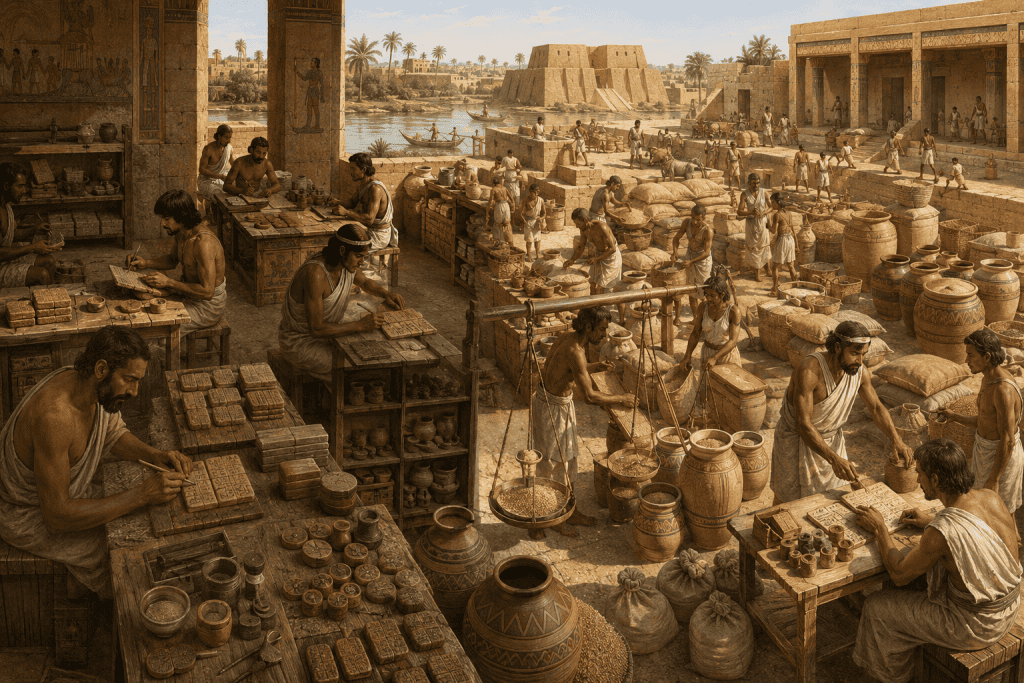
Administrative practices involving tokens, seals, and eventually clay tablets contributed to the development of proto-cuneiform around the end of the fourth millennium BCE. The earliest tablets were largely practical documents, recording commodities, rations, labor, and other economic information.
Writing therefore emerged not simply as a way to tell stories, but as a technology of administration.
Mesopotamia also demonstrates that early political development was not immediately centralized. Cities such as Uruk, Ur, Lagash, and others developed their own institutions and competed with one another long before the emergence of large territorial empires.
Egypt: A State Along the Nile
Egypt followed a different political trajectory.
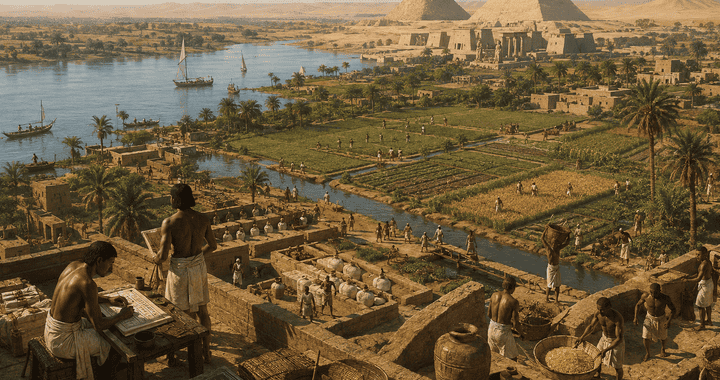
The Nile Valley provided a long, relatively narrow zone of fertile land surrounded by deserts. Communities developed along the river, where agriculture benefited from the annual flood cycle. By around 3100 BCE, political unification had produced a territorial state traditionally associated with the reign of Narmer.
Egyptian kingship became closely connected with religion and the maintenance of ma’at—a concept encompassing order, justice, and cosmic balance. The pharaoh was not simply a political administrator but occupied a unique religious position within Egyptian society.
The Egyptian state also demonstrated the power of centralized administration. Agricultural production, taxation, labor, construction, and religious institutions could be coordinated across a large territory.
Yet Egypt’s example should not be treated as a universal model. Its relatively unified monarchy was only one possible outcome of urban and agricultural development.
The Indus Valley: A Civilization Without Obvious Kings
The Indus or Harappan civilization presents one of archaeology’s most intriguing puzzles.
At its height, roughly 2600–1900 BCE, the civilization covered a vast area across parts of present-day Pakistan and northwestern India. Cities such as Harappa, Mohenjo-daro, and Dholavira featured carefully planned streets, standardized brick construction, sophisticated drainage systems, and standardized weights.
What they do not clearly reveal is equally important.
Archaeologists have found no universally accepted royal palace comparable to those of some other ancient civilizations, and there is limited evidence for the kind of monumental royal imagery seen elsewhere. The Indus script remains undeciphered, making it difficult to reconstruct the political institutions behind these cities.
That uncertainty has produced competing interpretations. The civilization may have been governed through regional elites, councils, merchant networks, or other institutions that did not depend on highly visible divine kingship.
The Indus world reminds us that urban complexity does not necessarily have to look like Egypt or Mesopotamia.
Caral-Supe: Cities Without Ceramics
Farther west, along the Pacific coast of Peru, another early urban tradition developed.
The Caral-Supe civilization, often called Norte Chico, flourished roughly between 3000 and 1800 BCE. Its settlements included monumental platform mounds, large plazas, and organized residential areas.
What makes Caral-Supe particularly striking is the economic system behind this development.
Coastal communities had access to abundant marine resources, while inland communities cultivated crops including cotton. Cotton was especially useful for producing fishing nets, creating an economic connection between agricultural and maritime communities.
Caral-Supe therefore challenges the assumption that the earliest complex societies had to be based on intensive cereal agriculture.
Its development suggests that trade, ecological diversity, and the organization of labor could also support monumental architecture and large settlements.
Early China: Bronze, Ritual, and Political Power
In northern China, complex political societies emerged through a different combination of agriculture, warfare, ritual, and metallurgy.
The Erlitou period, beginning around the second millennium BCE, is associated with increasingly complex urban centers and political institutions. Later, during the Shang period, cities such as Zhengzhou and Anyang became important centers of power.
Bronze technology was particularly significant. Bronze weapons and ritual vessels were closely associated with elite authority, while inscriptions on oracle bones provide direct evidence of political and religious concerns.
Shang rulers used divination to communicate with ancestors and supernatural forces, linking political authority with ritual power.
Here again, the path toward statehood was distinctive. Political organization was deeply connected to lineage, warfare, ancestor worship, and control over specialized craft production.
When Writing Became a Tool of Power
The emergence of writing fundamentally changed what early governments could do.
A society can transmit information through memory, speech, symbols, and social relationships. But writing allows information to travel beyond the limits of individual memory.
In Mesopotamia, clay tablets could record quantities of grain, livestock, labor, and other resources. In Egypt, early inscriptions and labels helped identify goods and administrative transactions. In China, inscriptions on oracle bones and bronze objects recorded political and religious information.
Writing did not automatically create the state. Rather, it gave emerging institutions a powerful new tool for managing increasingly complicated societies.
The ability to record an obligation meant that an institution could remember it after the original transaction. A written quantity could be checked. A tax could be calculated. A worker’s ration could be recorded. A ruler’s authority could be projected across distance.
Information became infrastructure.
The Human Cost of Urbanization
The rise of cities brought opportunities, but it also introduced new pressures.
Bioarchaeological evidence from early urban societies shows signs of nutritional stress, infectious disease, physical labor, and occupational injury in some populations. Dense settlements could facilitate the spread of disease, while agricultural specialization could reduce dietary diversity.
Burial practices also reveal growing social differences.
Elite graves in places such as Ur contain valuable materials including gold, lapis lazuli, and other imported goods. Royal and elite burials in early China similarly demonstrate enormous differences in wealth and status. In some contexts, human sacrifice or sacrificial retainers accompanied elite burials, revealing the extreme inequalities that could accompany political centralization.
The emergence of civilization therefore cannot be described simply as a story of technological progress.
It was also a transformation in the distribution of labor, wealth, authority, and freedom.
Did Civilization Require Coercion?
This question remains at the heart of the archaeological debate.
One influential explanation, associated with Karl Wittfogel’s hydraulic theory, argued that large irrigation systems required centralized management and therefore encouraged authoritarian states.
Another approach, developed by anthropologist Robert Carneiro, emphasized warfare and ecological circumscription: where growing populations faced limited access to land, competition could create conditions for political centralization.
James C. Scott offers a different perspective. He argues that early states were particularly well suited to extracting measurable resources such as grain and labor. From this perspective, the early state was not simply a vehicle for human progress but an institution capable of organizing—and coercing—large populations.
None of these explanations fully accounts for every early civilization.
The archaeological record suggests that states could emerge through combinations of environmental pressures, economic opportunities, warfare, trade, religious institutions, and administrative innovation. Different regions arrived at political complexity through different routes.
Civilization Was Not One Path
The greatest lesson from the earliest cities may be that there was never a single model of civilization.
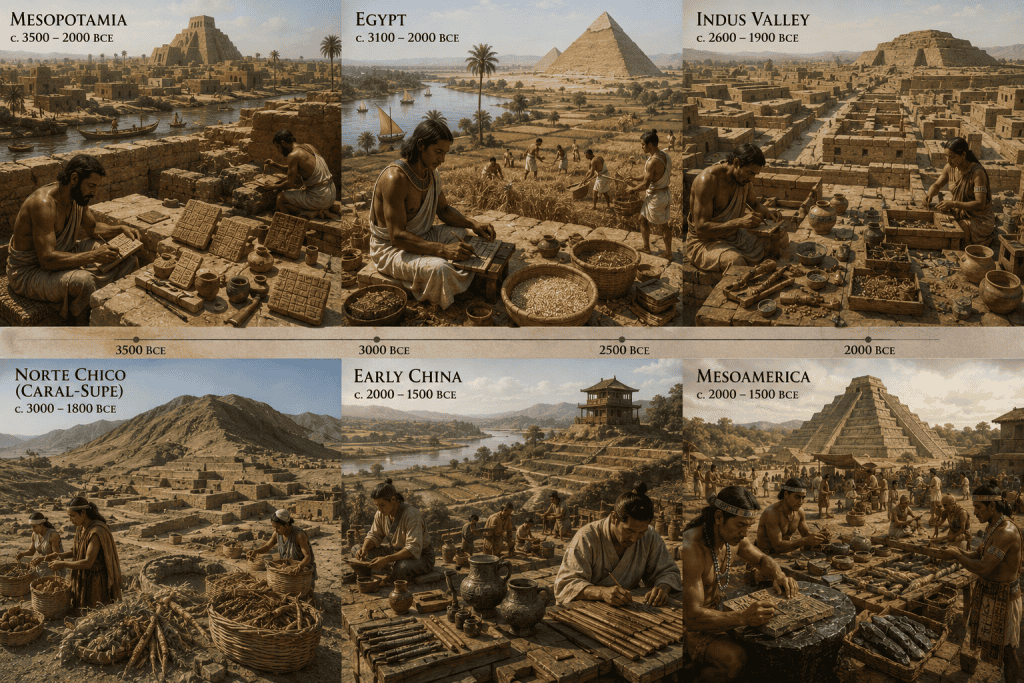
Mesopotamia produced competing city-states and eventually territorial empires. Egypt developed a powerful centralized monarchy. The Indus civilization created remarkably standardized cities whose political structure remains uncertain. Caral-Supe built monumental centers around an exchange between coastal and inland economies. Early Chinese states tied political authority to bronze production, warfare, lineage, and ritual.
These societies shared certain challenges: how to organize food, labor, trade, infrastructure, information, and social relationships at unprecedented scales.
But they did not solve those challenges in the same way.
That distinction matters. Civilization was not an inevitable evolutionary stage through which every society had to pass. It was a collection of historical choices and adaptations, shaped by local environments and social institutions.
The Legacy of the First Cities
The first civilizations established patterns that remain familiar today.
Governments still depend on records. States still measure populations and resources. Cities still concentrate wealth, labor, infrastructure, and political power. And societies still struggle to balance collective security with individual autonomy.
The earliest cities also demonstrate the fragility of complex systems. Climate shifts, political conflict, resource shortages, disease, and disruptions to trade could destabilize institutions that had taken centuries to build.
Their history therefore offers more than an origin story.
It offers a question.
How can large numbers of people cooperate without concentrating too much power in the hands of a few? How can institutions provide security without turning that security into control? And how can complex societies remain resilient when the environmental conditions on which they depend begin to change?
The people who built the first cities could not have known that their experiments would shape thousands of years of human history.
But their central problem remains with us.
How do we build societies capable of managing complexity without sacrificing human autonomy?