How Mansa Musa transformed West Africa’s natural resource monopoly into a global economic apparatus, enduring institutional power, and a lasting geopolitical legacy.
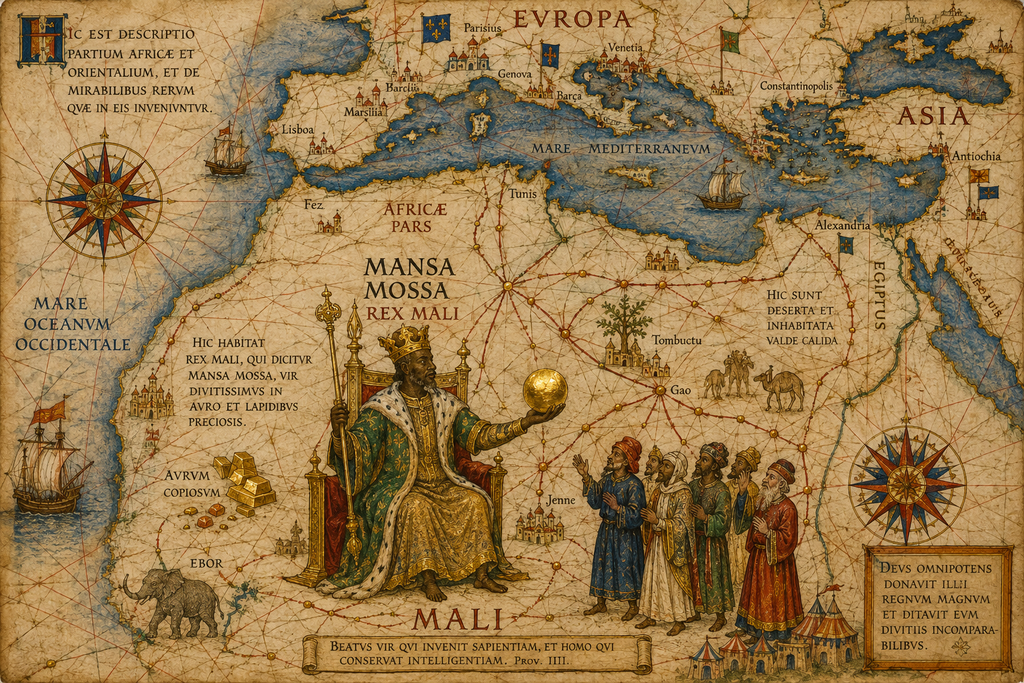
In the winter of 1375, the Majorcan cartographer Abraham Cresques completed the Catalan Atlas, an ambitious visual inventory of the known medieval world. Across its animal-skin parchment, trade routes snaked past European city-states, Mediterranean ports, and the principalities of the Levant. Yet at the center of West Africa, seated upon a gilded throne, sat an image that captivated the European imagination: a monarch wearing a tailored golden crown, holding a polished scepter in one hand and extending a heavy, gleaming orb of solid gold in the other.
The Latin inscription beside the figure made no attempt at subtle interpretation: “This Negro lord is called Musa Mali, Lord of the Negroes of Guinea. So abundant is the gold which is found in his country that he is the richest and most noble king in all the land.”
For a fourteenth-century Europe trapped in agrarian contraction, monetary scarcity, and impending political fracturing, the atlas delivered a startling revelation. The primary engine of global liquidity did not reside in the silver mines of Central Europe or the mercantile banks of Venice, but deep within the Niger River basin, controlled by a sovereign known as Mansa Musa.
In the centuries since, modern internet lore has flattened this sovereign into a singular trivia statistic: the “richest person in history,” routinely assigned an arbitrary net worth of 400 billion dollars. Popular accounts focus almost exclusively on his legendary 1324 pilgrimage to Mecca, describing a spendthrift king who casually crippled the economy of Cairo by handing out gold like loose sand.
Yet reducing Mansa Musa to a headline net worth misinterprets how medieval power operated and fundamentally misunderstands West Africa’s place in global history. Musa did not possess wealth in the sense of modern liquid equity or personal cash reserves; he commanded a sophisticated imperial state. His true achievement lay not in how much gold he extracted from the earth, but in how he constructed an economic, administrative, and cultural framework that turned a physical commodity into enduring institutional power.
The Imperial Architecture of the Manden
To understand the foundation of Musa’s financial reach, one must examine the state structures forged by his predecessors in the early thirteenth century. The Mali Empire arose out of the consolidation of the Mandinka kingdoms by Sundiata Keita, who dismantled the older Ghana (Wagadou) Empire and established a confederated imperial system governed by the Kouroukan Fouga—an oral constitution outlining administrative hierarchy, social roles, and resource rights.
Unlike Ancient Ghana, which acted largely as an intermediary standing between northern merchants and southern miners, Mali expanded directly into the primary gold-bearing regions of Bambuk, Bouré, and Galam. When Musa inherited the throne around 1312 CE following the mysterious departure of his predecessor, Mansa Abu Bakr II—who had embarked on a vast naval expedition into the Atlantic Ocean from which he never returned—he assumed command of an empire uniquely positioned at the nexus of global trade.
Mali occupied the fertile floodplain of the Niger River, providing the agricultural security needed to sustain large urban populations, standing armies, and specialized administrative classes. From this domestic base, the empire projected authority north into the Sahara, seizing control of critical trade settlements like Walata, Timbuktu, and Gao.
The imperial treasury maintained its solvency through a multi-tiered economic engine that functioned across several distinct layers:
The Gold Nugget Monopoly: To prevent runaway domestic inflation, the state enforced a strict legal division between unrefined gold dust and solid nuggets. While merchants and citizens freely used gold dust as a medium of exchange, every gold nugget discovered within the realm automatically became the exclusive property of the Mansa. This effectively capped internal money supply growth while reserving large bullion reserves for state expenditures and foreign trade.
The Dual Commodity Leverage: Gold carried value only to the extent that it could purchase foreign goods, and the item West Africa needed most was salt—essential for human biology and food preservation in the tropical interior. Mali asserted sovereign control over northern salt deposits such as Taghaza. By dictating terms at the intersection where northern salt met southern gold, the empire maintained exceptionally high profit margins on both commodities.
Universal Trade Levies: Every merchant entering or exiting the empire paid strict customs duties in goods or bullion at imperial checkpoints, turning trans-Saharan trade into a consistent stream of revenue for the state treasury.
Agricultural Redistribution: Stable agrarian production along the Niger River basin provided reliable food surpluses. This insulated urban centers from economic shocks and allowed the state to support a non-agricultural elite of administrators, soldiers, and scholars.
Musa’s wealth was not a personal collection of private property. In the Manden political system, the sovereign personified the fiscal authority of the state. Controlling these economic levers allowed the Mansa to wield unprecedented financial authority across the medieval world.
The Procession Across the Sahara
In 1324 CE, Mansa Musa departed his capital at Niani and set out toward Mecca. The journey was far more than an act of personal piety; it was a carefully calculated diplomatic mission designed to announce Mali’s emergence as a major power within the Islamic world.
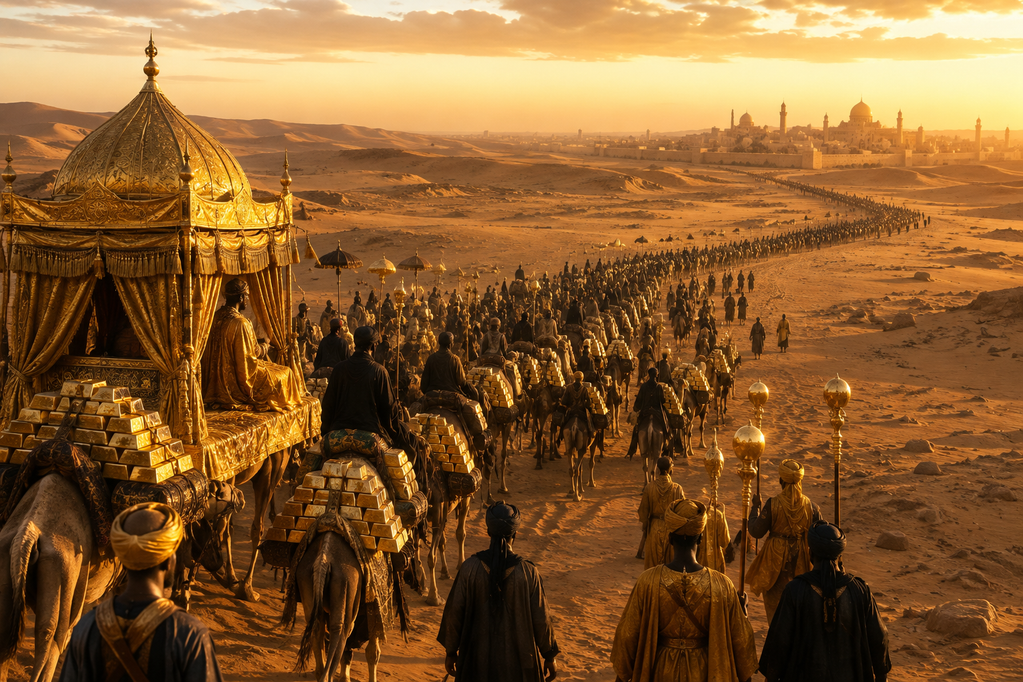
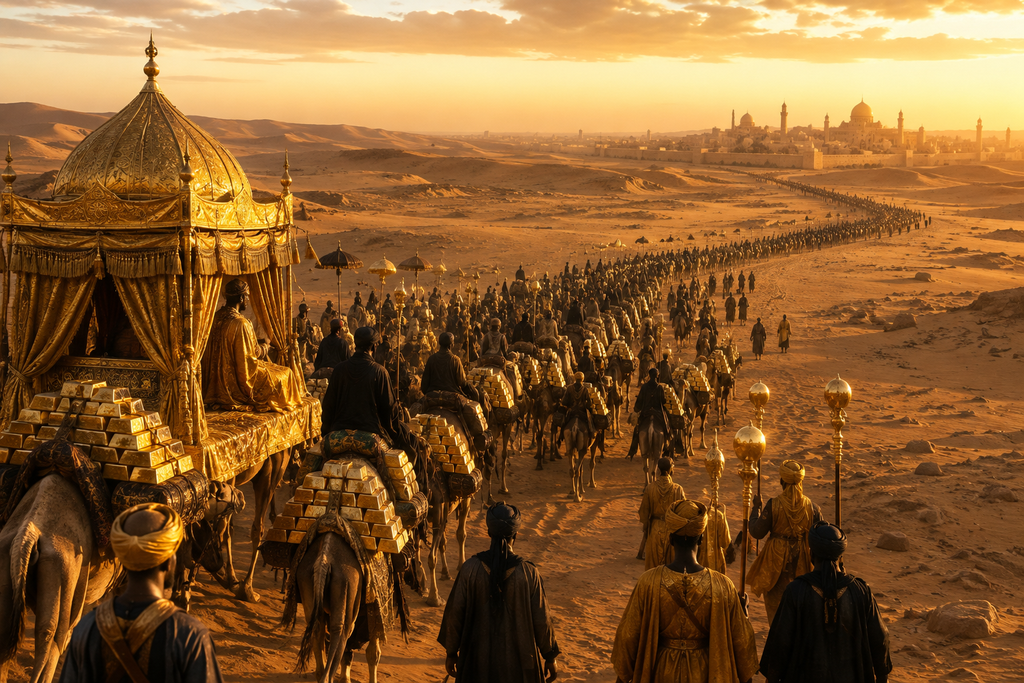
Medieval Arabic chroniclers, drawing on accounts from eyewitnesses and state officials, described a procession that stretched beyond the horizon. The caravan included tens of thousands of imperial guards, court officials, merchants, and attendants. Ahead of the monarch marched an advance guard of heralds dressed in fine silks, each carrying a staff of solid gold. Behind them followed a train of eighty to one hundred camels, each laden with hundreds of pounds of refined gold dust and bullion.
Setting out from Niani, the procession moved northward through Timbuktu and Walata, navigating the harsh trans-Saharan routes before making its grand entry into Cairo, the economic heart of the Middle East, and ultimately continuing to its religious destination in Mecca.
When the caravan arrived in Cairo in July 1324, it introduced a new dynamic to Mediterranean politics. The Mamluk Empire, which controlled Egypt and the Levant, was accustomed to treating sub-Saharan Africa as a distant periphery. Musa redefined that relationship through diplomatic protocol. Though he initially resisted bowing before the Mamluk Sultan al-Nasir Muhammad—insisting he bowed only to the God who created him—the two monarchs established an accord built on mutual respect and extensive gift exchanges.
Musa spent and distributed gold with lavish generosity, gifting thousands of ounces to government ministers, religious authorities, charitable foundations, and ordinary citizens. Yet this sudden influx of hundreds of kilograms of gold into a concentrated urban market produced unintended macroeconomic consequences.
The contemporary scholar Ibn Fadlallah al-Umari, visiting Cairo two decades later, recorded that the value of the gold dinar plummeted against the silver dirham, remaining depressed for over twelve years. He noted that gold had been held at a consistently high price in Egypt until the Malian caravan arrived, after which its value fell sharply and remained degraded for years.
Modern economic analysis confirms that Musa’s spending spree caused a localized inflationary shock, reducing the purchasing power of gold in Cairo’s mints by 10 to 25 percent. Demonstrating a sharp grasp of financial mechanics on his return journey, Musa borrowed back a substantial portion of the gold from local Egyptian merchants at elevated interest rates. This strategic retraction of bullion helped stabilize Cairo’s monetary base while securing line-of-credit arrangements that extended Mali’s economic reach into the Middle East.
From Bullion to Institutional Capital
If Mansa Musa had merely spent his fortune on luxury and political theater, his memory would have faded as a temporary historical anomaly. Instead, his legacy endures because he systematically converted raw wealth into permanent institutional capital.
On his return from the Arabian Peninsula, Musa brought back a distinguished contingent of scholars, jurists, theologians, and artisans. Among them was Abu Haq Es-Saheli, an Andalusian architect and poet from Granada. Musa commissioned Es-Saheli to design and construct monumental public works using innovative burnt-brick and rammed-earth engineering techniques.
This initiative transformed key urban centers across the Sahel through several targeted projects:
Architectural Innovation: Es-Saheli oversaw the construction of the Djinguereber Mosque in Timbuktu and the royal palace in Gao. These structures pioneered the Sudano-Sahelian architectural style—characterized by monumental earth walls, exposed timber beams, and dynamic thermal cooling systems tailored to desert environments.
The Sankore Intellectual Complex: Musa directed state funds into the development of the Sankore University system in Timbuktu. He financed endowed chairs for scholars, built extensive library facilities, and subsidized the housing of thousands of advanced students who traveled from across North Africa and the Middle East to study Islamic jurisprudence, mathematics, astronomy, and medicine.
The International Book Trade: Under Musa’s patronage, the manuscript trade emerged as one of the most profitable sectors of the Malian economy. The acquisition and copying of rare texts became status symbols for the elite, laying the foundation for private family libraries in Timbuktu that preserve tens of thousands of medieval manuscripts to this day.
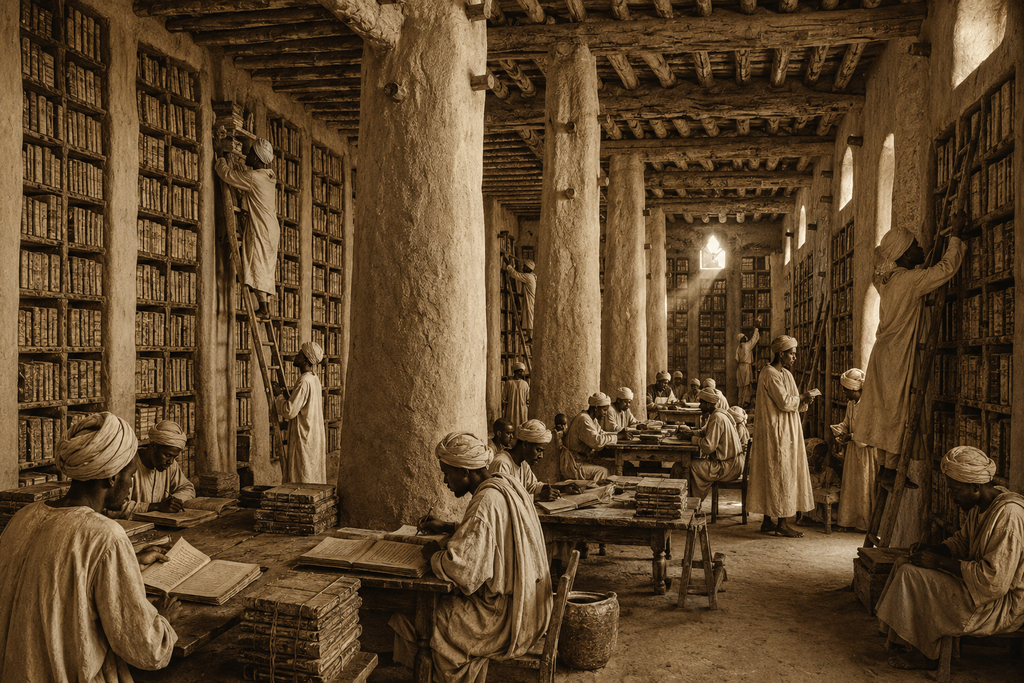
By investing in human capital and institutional infrastructure, Musa elevated Timbuktu from a seasonal desert trading post into a premier intellectual capital of the Islamic world.
The Fallacy of Modern Net-Worth Valuations
Modern media outlets frequently attempt to quantify Mansa Musa’s net worth, generating eye-catching figures ranging from 400 billion dollars to assertions that he was richer than anyone could describe. However, economic historians universally reject these numerical estimates as methodologically flawed.
Mapping a fourteenth-century imperial ruler onto modern net-worth metrics assumes the existence of liquid equity markets, sovereign bond valuations, and conversion rates between medieval gold and modern fiat currencies that simply did not exist. In medieval West Africa, wealth was tied to sovereign authority, control over labor, tributary relationships, and land rights—none of which can be converted into modern market valuations.
Furthermore, attempting to isolate Musa’s personal bank account from the treasury of the Mali Empire is anachronistic. Musa was the sovereign state. His access to gold was not a personal asset balance sheet; it was the operating budget of an empire.
Converting medieval gold tonnage into modern currencies using current spot prices distorts how value functioned in the fourteenth century. Gold was not merely an asset class; it was the foundation of international monetary diplomacy. Musa’s true power lay not in a static net worth figure, but in his capacity to mobilize human resources, command trade routes, and deploy capital across continents.
Historically, interpretations of his reign have varied across different scholarly eras. Institutionalist historians emphasize Musa as a pragmatic state builder who leveraged gold to integrate Mali into international financial and scholarly networks. In contrast, earlier Eurocentric scholars viewed his spending in Cairo primarily as an act of lavish ostentation that inadvertently destabilized the Mamluk monetary system. Modern economic revisionists take a more nuanced view, demonstrating that Cairo’s inflation was actually driven by broader Mediterranean monetary shifts, which Musa’s influx of gold amplified rather than caused entirely on its own.
Debate also surrounds the precise nature of imperial control over the gold fields. Early accounts assumed the Mansa owned the mines outright and operated them through forced labor. Modern anthropological and historical research reveals a far more complex system: local mining communities operated with significant autonomy, while the central state exerted control by taxing the trade bottlenecks where raw commodities were brought to market.
The Enduring Legacy of the Golden Monarch
Mansa Musa died around 1337 CE, leaving behind an empire at the height of its political prestige, economic reach, and cultural influence. Although internal dynastic disputes and shifting trade routes eventually eroded Mali’s dominant position over the following two centuries, the institutional framework established during Musa’s reign left an indelible mark on West Africa.
Musa’s administration provides an early historical example of how to manage a major natural resource boom. Rather than succumbing to economic imbalances where commodity extraction undermines domestic enterprise, he used state revenues to diversify the economy. He fortified agrarian production along the Niger River, established international trade alliances, and built an intellectual infrastructure that outlasted the political empire itself.
The depiction of Musa on the 1375 Catalan Atlas stands as a historical marker. It captures a moment when West Africa sat at the center of global trade, driving Mediterranean monetary systems and setting a standard for political governance. Mansa Musa demonstrated that true wealth is not measured by the physical commodities a sovereign hoards, but by a state’s capacity to translate its resources into enduring institutions, intellectual progress, and lasting human achievement.