RESEARCH BRIEF & EXECUTIVE SUMMARY
| RESEARCH INTELLIGENCE BRIEF This article presents an evidence-backed synthesized overview of how early hominins transitioned from opportunistic wildfire consumers to deliberate fire producers. It resolves major popular misconceptions, distinguishes between natural fire exposure and cognitive fire control, details crucial archaeological sites, and evaluates the biological and cultural impacts of thermal food processing. |
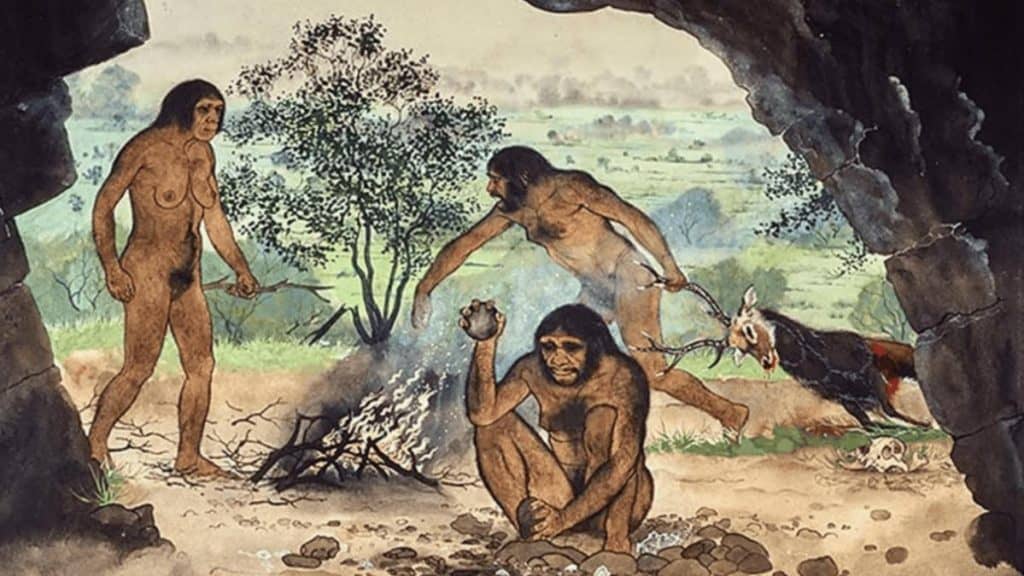
Core Thesis: The mastery of fire represents one of the most profound technological thresholds in human lineage. Unlike tool-making, which has rudimentary analogs among non-human primates, the deliberate maintenance and eventual creation of fire is uniquely hominin. Rather than a singular moment of discovery, historical and archaeological evidence demonstrates a multi-stage evolutionary process spanning over a million years—transitioning from passive opportunistic exploitation of natural wildfires to active preservation, spatial containment, and ultimately chemical ignition.
Evolutionary Timeline: 1. Passive Exploitation & Interaction (1.8–1.5 Million Years Ago): Early hominins like Homo erectus encountered natural fires caused by lightning or volcanic activity, utilizing thermal residual energy for heat and foraging burned animal remains.
2. Fire Maintenance & Control (1.0 Million – 400,000 Years Ago): Hominins learned to transport glowing embers, establish rudimentary spatial hearths, and continuously supply biomass fuel.
3. Fire Production & Technological Mastery (400,000 – 150,000 Years Ago): Neanderthals and early Homo sapiens developed intentional ignition techniques using percussion (striking flint against pyrite) or friction (fire drills).
Evidence Strength Assessment: Very Strong (Thermal alteration of sediments at Wonderwerk Cave ~1.0 Ma; burnt bones and fire hearth structures at Gesher Benot Ya’aqov ~780,000 BP; widespread habitual hearth structures across Europe and Africa from 400,000 BP onward). Speculative/Debated (Claims of fire control prior to 1.5 Ma based on burnt clay patches without structural context).
Introduction: Re-evaluating the Spark of Human Civilization
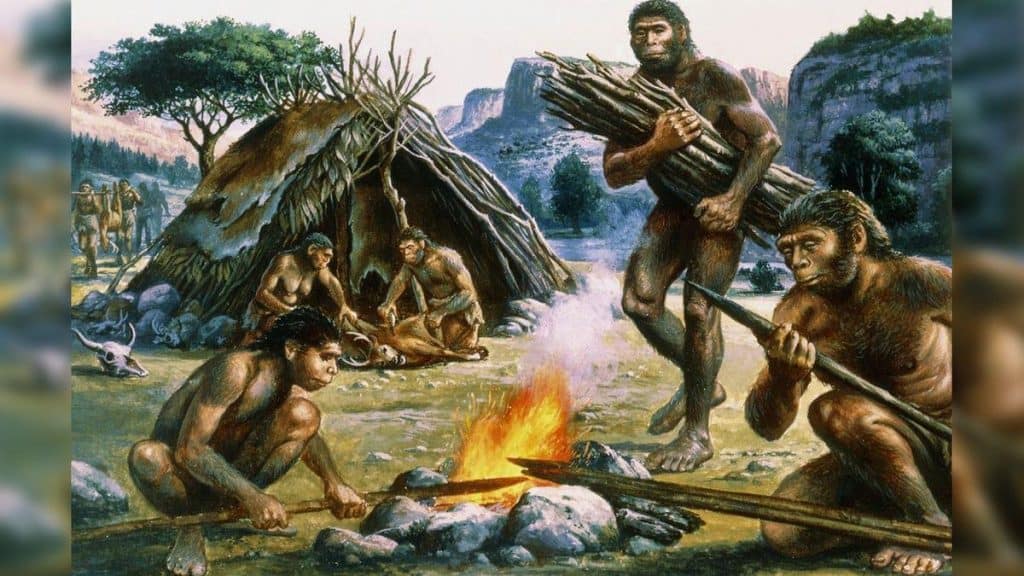
Every modern technology, from the smelting of bronze age axes to the launch vehicles that orbit our planet, traces its lineage back to a single primordial catalyst: the mastery of fire. Yet, popular imagination frequently misinterprets this milestone. Popular culture often depicts a lone caveman striking two stones together and instantly transforming human existence in a single stroke of genius. The reality discovered by modern archaeologists, paleoanthropologists, and evolutionary biologists is vastly richer, more gradual, and infinitely more fascinating.
The discovery of fire was not an isolated event or a sudden invention. Fire has existed on Earth for over 400 million years, ever since land plants produced sufficient atmospheric oxygen and organic biomass to sustain combustion triggered by lightning. Early hominins did not ‘invent’ fire; rather, over hundreds of thousands of years, our ancient ancestors developed a complex behavioral and cognitive relationship with one of nature’s most volatile forces.
Learning to interact with, capture, maintain, and eventually ignite fire fundamentally reshaped human biology and culture. It shrank our digestive tracts, expanded our energy-hungry brains, extended our active hours past sunset, offered protection against apex predators, and laid the foundations for human social organization. Understanding the control of fire is nothing less than understanding how we became human.
What Does the ‘Discovery of Fire’ Really Mean?
To understand the history of fire, scientists meticulously distinguish between four distinct behavioral stages in early hominin development:
1. Opportunistic Interaction: Early hominins, much like savannah animals today, observed natural wildfires caused by lightning, volcanism, or spontaneous combustion. While most animals flee, early ancestors recognized that newly burned landscapes offered foraging advantages—such as exposed tubers and roasted animals.
2. Opportunistic Fire Use: Hominins began harvesting naturally burning branches from wildfire edges to keep a small blaze alive temporarily. This provided immediate benefits—heat and light—without the ability to maintain it long-term or create it at will.
3. Controlled Fire Use: The capacity to deliberately transport embers to a specific location (a hearth or shelter), continuously feed the fire with targeted fuel, protect it from rain, and keep it burning continuously for extended periods.
4. Fire Production (Ignition): The ultimate technological breakthrough: generating fire on demand using friction (wood drills) or chemical percussion (flint and iron pyrite), independent of naturally occurring blazes.
When asking ‘when did humans discover fire?’, answer precision requires clarifying which stage is being referenced. While opportunistic fire use likely stretches back nearly two million years, habitual controlled fire use and artificial production emerged much later in human prehistory.
How Early Humans First Encountered Fire
Long before hominins ever touched a burning branch, natural wildfires swept across the African savannahs. Lightning strikes during dry seasons triggered sweeping bushfires, leaving behind altered landscapes. For most species, fire was a terrifying hazard that prompted immediate flight. However, early hominin species—such as Australopithecus and early Homo erectus—developed an unusual behavioral response: curiosity and ecological exploitation.
Observing fire’s behavior revealed clear ecological opportunities. Wildfires cleared dense underbrush, driving out small game and revealing burrows. Furthermore, the heat naturally cooked fruits, seeds, and animal carcasses caught in the flames. Modern studies of wild chimpanzees show that apes intentionally monitor grass fires, calmly foraging along the advancing perimeter to consume heat-softened seeds and burnt insects. Early hominins likely possessed similar or superior observational capabilities, learning that wild blazes were not merely destructive forces, but valuable ecological feeding grounds.
Archaeological Footprints: The Earliest Evidence of Human Fire Use
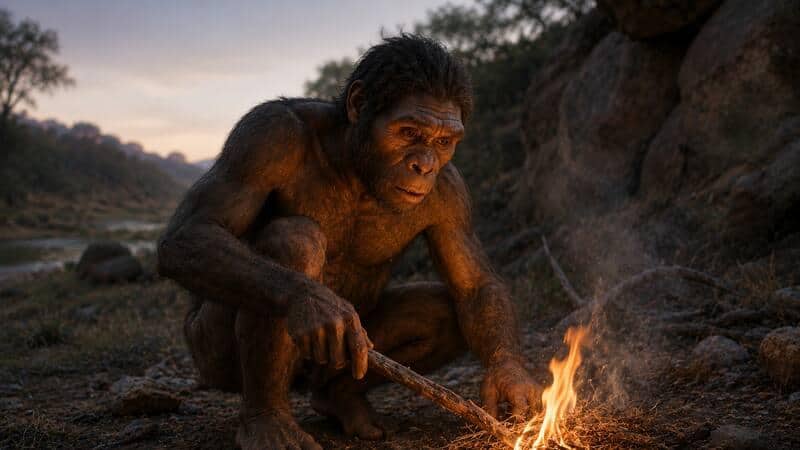
Unearthing physical evidence of fire from hundreds of thousands of years ago is extraordinarily challenging. Ash and charcoal wash away, wind disperses organic traces, and natural bushfires leave burnt patches that look identical to primitive campsites. Archaeologists rely on sophisticated micro-stratigraphic analysis, Fourier-transform infrared spectroscopy (FTIR), and paleomagnetic testing to differentiate natural blazes from intentional hominin hearths.
Wonderwerk Cave, South Africa (~1.0 Million Years Ago)
Located in the Northern Cape province, Wonderwerk Cave provides some of the earliest convincing evidence of early human fire interaction. Deep inside the cave—roughly 30 meters from the entrance—researchers discovered micro-stratigraphic layers containing burnt bone fragments, melted ash, and heat-fractured stone tools dating to approximately one million years ago. Because natural wildfires cannot penetrate deep into dark cave interiors, the presence of localized burning at this depth strongly implies that Homo erectus carried burning materials inside intentionally.
Gesher Benot Ya’aqov, Israel (~780,000 Years Ago)
Situated along the Jordan Rift Valley, the site of Gesher Benot Ya’aqov offers remarkable spatial evidence of organized fire control. Archaeologists identified localized concentrations of burnt flint micro-artifacts, wood charcoal, and charred seeds from olive, oak, and barley trees. Crucially, burnt artifacts were clustered in specific areas rather than scattered randomly across the site, demonstrating that early humans maintained localized, repeated hearths rather than experiencing an accidental natural fire.
Qesem Cave, Israel (~400,000–300,000 Years Ago) & European Sites
By 400,000 years ago, clear evidence of habitual, controlled hearth usage becomes abundant across Eurasia and Africa. Sites such as Qesem Cave in Israel, Beeches Pit in the United Kingdom, and Schöningen in Germany display thick, repeated ash layers, structured hearth rings, and high-temperature altered sediments. By this epoch, fire was no longer an occasional luxury; it had become an integral part of hominin daily life.
Key Archaeological Sites Documenting Early Fire Control
| Site Name | Approx. Age | Hominin Species | Key Archaeological Evidence |
| Wonderwerk Cave (South Africa) | ~1.0 Million BP | Homo erectus | Microscopic ash and burnt bones deep inside cave interior where natural fires cannot reach. |
| Gesher Benot Ya’aqov (Israel) | ~780,000 BP | Homo erectus / Heidelbergensis | Spatially clustered burnt flints, charcoal, and burned plant remains indicating localized hearths. |
| Qesem Cave (Israel) | ~400,000 BP | Archaic Homo sapiens | Repeated thick ash hearth structures, butchered bones exposed to controlled cooking temperatures. |
| Beeches Pit (United Kingdom) | ~400,000 BP | Homo heidelbergensis | Spatial hearth footprints with heated knapped flint artifacts fitting back together around fire bounds. |
How Early Humans Preserved and Made Fire
Long before humans knew how to start a fire from scratch, they mastered the art of fire preservation. Maintaining a continuous flame was far easier than rekindling one. Early groups likely assigned dedicated ‘firekeepers’ responsible for feeding coals with slow-burning hardwoods and damp moss.
When migrating or hunting, hominins carried fire across long distances using portable coal containers. Slow-burning fungi (such as Fomes fomentarius, commonly known as tinder fungus or horse hoof fungus), wrapped tightly in green leaves and packed in animal hide pouches or hollowed horns, could smolder safely for hours. Upon reaching a new campsite, blowing gently onto the smoldering fungal core against dry grass instantly generated a fresh flame.
The Transition to Deliberate Fire Production
The development of artificial ignition was a revolutionary leap in chemical technology. Archaeologists believe humans developed two primary methods for making fire on demand:
1. Friction Ignition (Wood-on-Wood): By rapidly spinning a dry wooden spindle against a wooden hearth-board (hand drill or bow drill), friction generates fine wood dust and intense heat. Eventually, the dust reaches ignition temperature (~300°C / 570°F), forming a glowing ember that can be transferred into a tinder bundle.
2. Percussion Ignition (Mineral Strike): Striking a piece of hard stone (such as flint or quartz) against iron pyrite (sulfide mineral) produces hot, long-lasting mineral sparks. When these sparks land on prepared tinder fungus or charred plant fiber, they ignite quickly.
The iconic discovery of ‘Ötzi the Iceman’—a 5,300-year-old mummy found in the Alps—yielded a complete fire-making kit, including flint tools, iron pyrite nodules, and dried tinder fungus impregnated with mineral dust. However, percussion artifacts found in European Neanderthal sites suggest mineral strike ignition was practiced as early as 50,000 to 100,000 years ago.
Fire, Food, and Human Evolution: The Cooking Hypothesis
Why was fire so transformative? While warmth and light were crucial, evolutionary biologist Dr. Richard Wrangham proposed a ground-breaking perspective known as the ‘Cooking Hypothesis’ (detailed in his seminal work Catching Fire: How Cooking Made Us Human). Wrangham argues that cooking was not merely a cultural convenience, but the primary biological driver that created the genus Homo.
| THE COOKING HYPOTHESIS IN A NUTSHELL Cooking acts as an external stomach. By using thermal energy to denature proteins, gelatinize starches, and break down tough plant fibers outside the body, cooking dramatically reduces the metabolic energy required for internal digestion. This metabolic surplus directly fueled the expansion of the human brain. |
Raw meat and tough wild tubers require massive digestive expenditure and hours of intense chewing. Great apes, such as chimpanzees, spend up to six hours every day chewing raw food to extract sufficient calories. By subjecting raw food to thermal degradation (cooking):
1. Collagen in connective tissue breaks down into soft gelatin, and complex proteins denature into easily digestible amino acids.
2. Starches inside plant cell walls undergo gelatinization, increasing caloric availability by up to 50% compared to raw consumption.
3. Toxic secondary compounds and plant defense chemicals are neutralized, dramatically expanding the hominin edible menu.
4. Harmful foodborne bacteria, parasites, and pathogens are eliminated, significantly increasing survival rates among infants and juveniles.
This dietary change produced dramatic physical alterations in human anatomy visible in the fossil record. As Homo erectus transitioned to cooked food, the massive jaws, heavy chewing muscles, and long digestive tracts typical of Australopithecus shrank. Because the gut is a highly expensive tissue to maintain metabolically, shrinking the intestine freed up vast amounts of metabolic energy. That excess energy was redirected directly to growing the most energy-hungry organ in the animal kingdom: the human brain.
Fire for Warmth, Protection, and Migration

Beyond cooking, fire altered how early humans interacted with their environment, serving as a multi-purpose survival technology:
Predator Defense: Before fire, early hominins were vulnerable prey in the darkness of the African night. Apex predators like sabertooth cats (Homotherium), giant hyenas, and leopards ruled the night. Fire provided a powerful physical barrier; wild animals naturally fear open flame and smoke. Gathering around a hearth allowed hominins to sleep safely on the ground rather than nesting in trees.
Climate Adaptation and Global Migration: Early hominins originated in tropical East Africa. Expanding into temperate zones—such as Eurasia, glacial Europe, and high-altitude regions—was biologically impossible without artificial thermal insulation. Fire acted as a portable climate, allowing Homo erectus, Neanderthals, and Homo sapiens to survive freezing winters, cross icy mountain passes, and colonize the globe.
Tool Hardening and Pyrotechnology: Fire transformed toolmaking from crude stone-flaking into advanced pyrotechnology. Early humans learned that heating wooden spear tips hardened the grain, making them far more durable. Later, Neandertals used controlled fire to distill birch bark tar—producing the world’s first industrial synthetic adhesive to haft stone blades onto wooden shafts.
Fire and the Birth of Human Social Culture
Perhaps the most subtle yet revolutionary impact of fire was social. Before fire, hominin activity was strictly dictated by the sun. When darkness fell, activity ceased. Fire effectively extended the day by several hours, creating a brand-new social space: the evening campfire.
Anthropologist Polly Wiessner studied modern hunter-gatherer communities (such as the Ju/’hoansi of Southern Africa) to understand the social impact of nighttime firelight. Her research revealed a striking contrast: daytime conversations primarily focus on practical matters, hunting logistics, and resource gathering. Nighttime conversations around the fire, however, revolve almost entirely around storytelling, singing, myth-making, and discussing social relationships.
Sitting together in a circle around a shared hearth fostered unique psychological dynamics:
• Eye contact and non-verbal communication were heightened in the soft glow of firelight.
• Shared meals around a central fire required rules for food distribution, encouraging empathy and social fairness.
• Storytelling around campfires fostered language complexity, symbolic thought, cultural memory, and tribal identity.
In essence, the hearth became the world’s first classroom, theater, and social network.
Common Myths About the Discovery of Fire
Despite decades of scientific research, several persistent myths continue to confuse popular understanding of human fire mastery:
DEBUNKING POPULAR MISCONCEPTIONS:
Myth 1: A single prehistoric genius ‘invented’ fire.
Fact: Controlling fire was a cumulative, multi-generational evolutionary process carried out by different hominin species (Homo erectus, Neanderthals, Homo sapiens) across hundreds of thousands of years.
Myth 2: Early humans made fire as soon as they began using it.
Fact: There was a massive time gap—likely hundreds of thousands of years—between early humans opportunistic use of natural wildfire coals and their ability to generate fire artificially on demand.
Myth 3: Fire control was unique to modern Homo sapiens.
Fact: Strong archaeological evidence confirms that Neanderthals (Homo neanderthalensis) and Homo heidelbergensis routinely controlled fire, built structured hearths, and produced birch pitch adhesive using fire long before Homo sapiens migrated into Europe.
Frequently Asked Questions (FAQs)
Q: Did Homo sapiens discover fire?
A: No. Fire control was mastered long before modern Homo sapiens evolved. Ancestral species such as Homo erectus were utilizing and maintaining fire at least one million years ago, hundreds of thousands of years before Homo sapiens emerged around 300,000 years ago.
Q: How did early humans first make fire without matches?
A: Early humans used two primary friction and percussion methods: striking flint against iron pyrite minerals to create sparks, or rapidly rubbing hard wooden sticks against softer wooden hearth-boards (hand drills/bow drills) to generate glowing wooden embers.
Q: What is the oldest known evidence of fire used by early humans?
A: The oldest widely accepted evidence comes from Wonderwerk Cave in South Africa (~1.0 million years old), where micro-stratigraphic ash and burnt bones were found deep inside a cave, far beyond the reach of natural brushfires.
Q: How did cooking fire change human physical appearance?
A: Cooking tenderized food, causing human jaws, teeth, and digestive tracts to shrink significantly over evolutionary time. The saved metabolic energy was redirected toward growing much larger brains.
Q: Did Neanderthals know how to make fire?
A: Yes. Archaeological evidence shows Neanderthals built organized hearths, used fire to craft birch-bark tar adhesive, and used manganese dioxide and flint-on-pyrite strike technology to produce fire at will.
Q: How did early humans keep fire burning overnight?
A: Early humans maintained fires by banking coals—covering hot embers with layers of ash, damp moss, or slow-burning hardwood logs to restrict oxygen, allowing embers to glow safely until blown back into flame the following morning.
Q: Why did wild animals not attack early human fires?
A: Wild animals possess an innate fear of open fire and smoke. Early humans utilized this fear strategically, building hearth perimeters around sleeping areas to create safe zones against nocturnal predators.
Q: What is the difference between opportunistic fire use and fire production?
A: Opportunistic fire use involves harvesting embers from naturally occurring wildfires (caused by lightning) and maintaining them. Fire production is the technological ability to create fire artificially whenever needed.
Conclusion: The Enduring Legacy of the First Spark
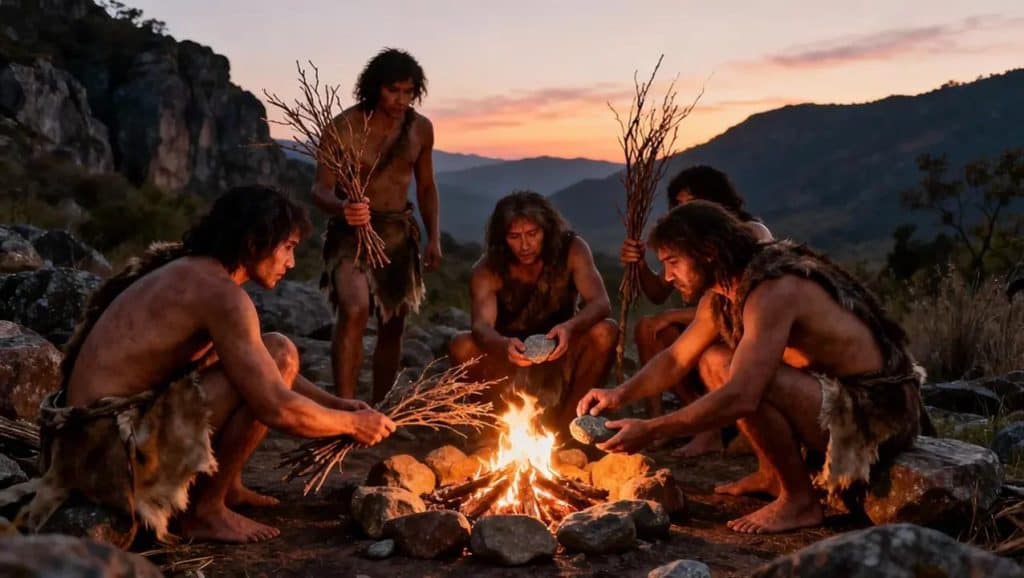
The control of fire was the foundational event that set humanity on a fundamentally distinct evolutionary trajectory. By learning to tame nature’s most destructive force, our ancient ancestors altered their own biology, expanded their cognitive capabilities, created rich social traditions, and unlocked the power to reshape their environment.
From the humble hearth fires of Wonderwerk Cave to modern internal combustion engines, industrial furnaces, and thermal rocket propulsion, human civilization remains fundamentally fire-powered. Every time we gather around a campfire, light a candle, or cook a meal, we participate in an unbroken human tradition that began over a million years ago—a tradition born from curiosity, nurtured by ingenuity, and lit by the very spark that made us human.
Sources and Further Reading
• Wrangham, Richard. Catching Fire: How Cooking Made Us Human. Basic Books, 2009.
• Berna, Francesco, et al. ‘Microstratigraphic evidence of in situ fire in the Acheulean strata of Wonderwerk Cave, Northern Cape province, South Africa.’ Proceedings of the National Academy of Sciences 109.20 (2012): 7815-7820.
• Goren-Inbar, Naama, et al. ‘Evidence of hominin use of fire at Gesher Benot Ya’aqov, Israel.’ Science 304.5671 (2004): 725-727.
• Wiessner, Polly W. ‘Embers of society: Firelight talk among the Ju/’hoansi Bushmen.’ Proceedings of the National Academy of Sciences 111.39 (2014): 14027-14035.
• Sorensen, Andrew C., et al. ‘Neanderthal fire-making technology inferred from microwear analysis of Mousterian bifaces.’ Scientific Reports 8.1 (2018): 10065.
• Gowlett, John A.J. ‘The discovery of fire by humans: a long and convoluted process.’ Philosophical Transactions of the Royal Society B: Biological Sciences 371.1696 (2016): 20150164.
• Smithsonian National Museum of Natural History. ‘Human Origins Program: Earliest Evidence of Human Fire Control.’ Smithsonian Institution, 2022.