Waking Up in the 31st Century
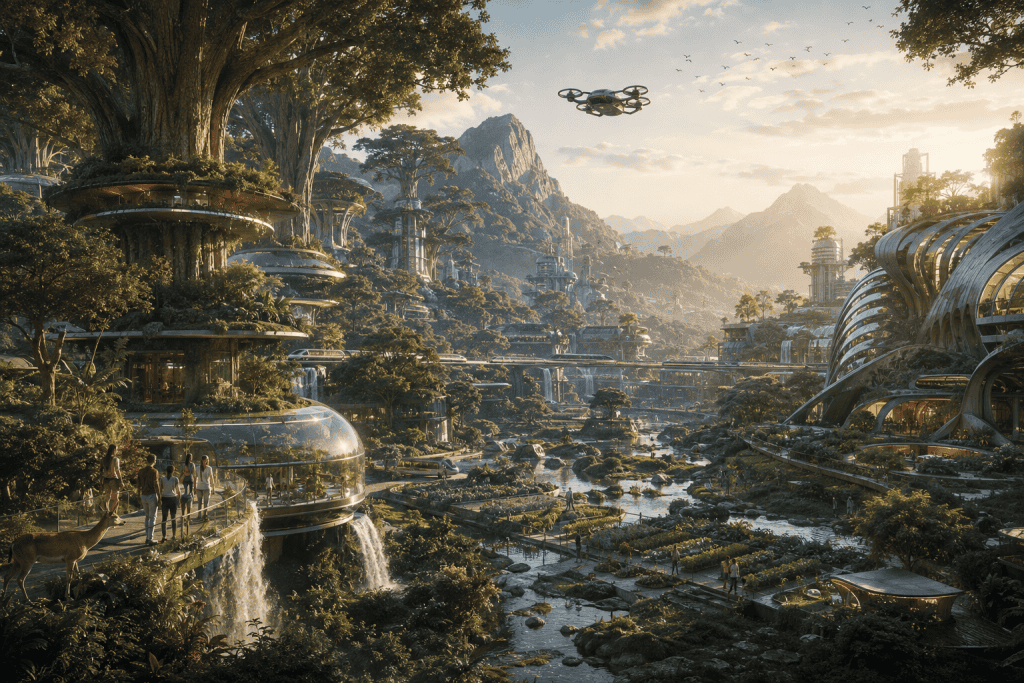
Imagine waking up on Earth on a quiet morning in the year 3000. A traveler stepping into this world after a thousand-year slumber would not encounter a chaotic sky of flying metal cars or glowing neon towers. Instead, the first overwhelming sensation might be silence. The continuous, low-frequency roar of internal combustion engines, jet turbines, and centralized industrial electrical grids that defined the 20th and 21st centuries has completely vanished.
Above, the sky carries a hue controlled by planetary atmospheric management arrays. The coastlines visible from space no longer mirror the geography of the year 2000; sea levels have adjusted to thermal expansion set in motion a millennium prior. Structures do not appear built; they appear grown—composed of self-healing biomimetic composites that harvest sunlight and ambient moisture. The inhabitants appear human, yet operate on radically altered biological parameters. Inherited genetic disease was erased centuries ago, and their neural pathways interact directly with non-biological computational networks embedded in the atmosphere itself.
Predicting life a thousand years into the future requires profound intellectual humility. Someone standing in the year 1000 CE could not have conceptualized quantum computing, genetic engineering, satellite communications, or thermonuclear power. The gap between 1000 CE and today was forged by non-linear disruptions. The gap between today and 3000 CE will be equally vast, shaped by transformations that challenge linear extrapolation.
Historical Foundations: A Thousand Years Is Longer Than We Think
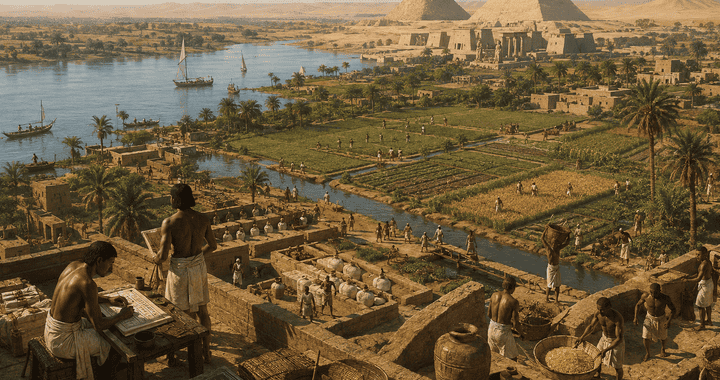
To evaluate a millennium, we must confront the limits of human forecasting. Most institutional planning spans 5 to 50 years. A thousand years stretches across forty human generations, rendering specific political, linguistic, or cultural predictions obsolete. In 1000 CE, world population sat at roughly 250 million; energy systems were strictly agrarian; information moved at the speed of a sailing ship or draft horse.
Over a thousand-year window, compounding non-linear changes reshape civilization. A modest 1% annual growth in energy capture or scientific capability yields a multi-thousand-fold expansion over ten centuries. However, progress is rarely a smooth upward line. History demonstrates that civilizations experience plateaus, system failures, and ecological realignments. The world of 3000 will not merely be modern life with faster machines—it will be a civilization rebuilt on entirely new energetic, biological, and computational foundations.
What Will Earth Look Like? The Physical Planet
Regardless of human technological sophistication, Earth’s physical systems remain bound by atmospheric chemistry and thermodynamics. However, Earth’s physical state in 3000 will reflect the multi-century tail of human industrial activity initiated in the 19th century.
According to research published by climate scientist David Archer and frameworks analyzed by the IPCC, between 15% and 40% of released anthropogenic carbon dioxide remains elevated in the atmosphere for over a thousand years after emissions cease. Because of deep-ocean thermal inertia, heat absorbed by marine waters is released back to the atmosphere across centuries. By 3000, sea levels are committed to being 2 to 10+ meters higher, permanently re-drawing low-lying coastal geography worldwide.
By the 31st century, human interaction with Earth’s biosphere will have transitioned from unintended degradation to active planetary systems management. Earth will neither be an untouched wilderness nor a paved industrial ruin; it will be an engineered biosphere. Planetary-scale carbon capture, synthetic biology, and precision hydrology will actively manage biomes to preserve ecological balance and prevent runaway climate instability.
Will Cities Still Look Like Cities?
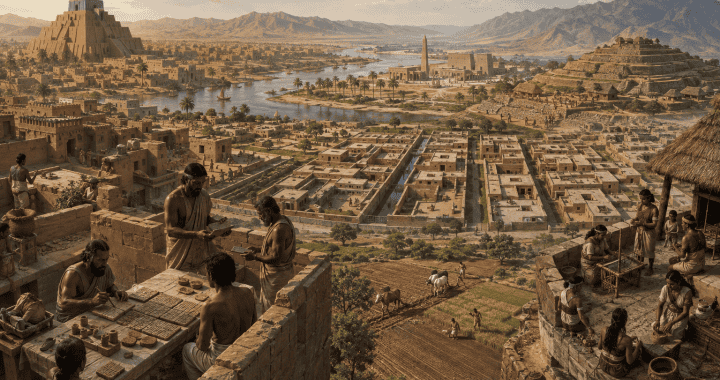
Urban design has evolved from walled Mesopotamian sanctuaries to dense electrified megacities. By 3000, urban spaces will be defined by advanced material science, automated construction, and complete environmental integration.
Traditional inert construction materials like concrete and steel will be largely replaced by living infrastructure—bio-synthetic composites that absorb carbon, self-repair micro-fractures, and dynamically adjust thermal insulation. To minimize land consumption and allow wild ecosystems to regenerate, cities will expand vertically and subterraneanly into arcologies: hyper-dense, multi-kilometer structures housing hundreds of thousands of individuals with internal closed-loop water, food, and energy systems.
Evolution and Turning Points: Transportation & Space Settlement
Transportation is fundamentally a function of energy density and material tensile strength. On Earth, surface transit will move through subterranean vacuum tubes using magnetic levitation, allowing transcontinental pods to travel at hypersonic speeds without atmospheric friction.
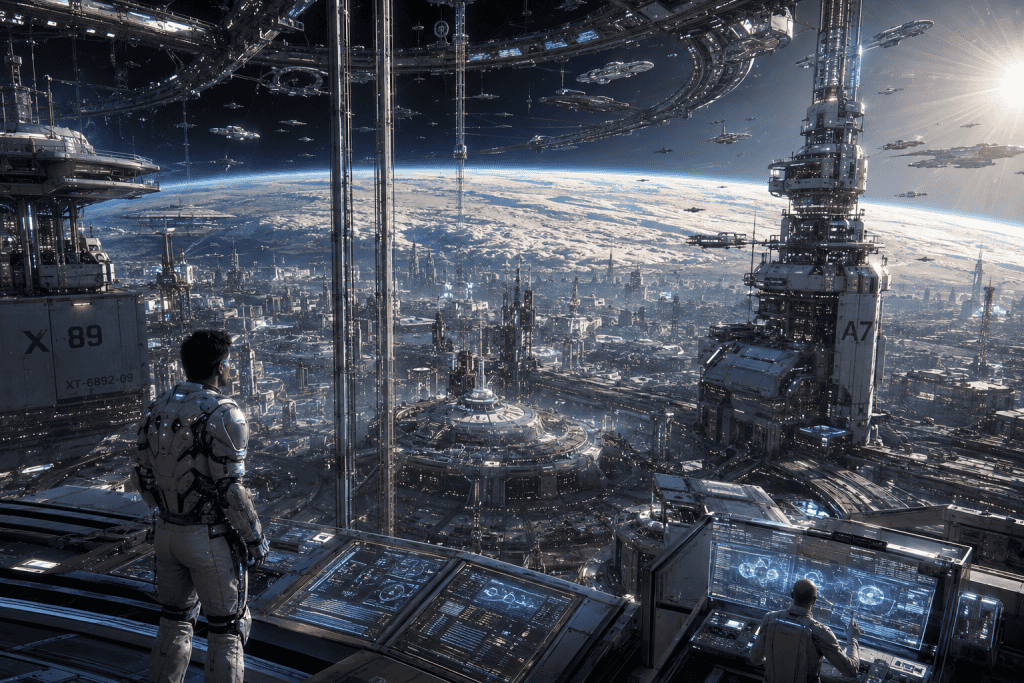
To bypass the high energy costs of chemical rockets, space access in 3000 will rely on non-rocket propulsion infrastructure. If material science produces ultra-high-tensile carbon nanotube or graphene lattices, orbital space elevators extending from Earth’s equator to geostationary orbit will transport cargo and passengers into space at a fraction of modern energy costs.
Across the solar system, permanent self-sustaining human habitats will exist on the Moon (inside subterranean lava tubes shielded from radiation), Mars (in pressurized basin arcologies with early-stage atmospheric enhancement), and within rotating orbital O’Neill cylinders simulating Earth gravity. However, interstellar travel to other star systems will remain constrained by relativistic speeds and radiation barriers, keeping the vast majority of humanity within our solar system.
Evidence and Analysis: Artificial Intelligence & Human Biology
Artificial intelligence will serve as the nervous system of 31st-century civilization. Rather than operating as standalone software applications, AI will manage planetary resource distribution, fusion energy grids, climate intervention, and automated scientific discovery. AI systems will compress centuries of theoretical physics and material research into months.
Simultaneously, human biology will no longer be dictated solely by random genetic mutation. Genomic editing, nanomedical cellular repair, and senescence reversal will eliminate inherited genetic diseases and extend healthy human lifespans to several centuries. Through high-bandwidth brain-computer interfaces, human cognition will integrate directly with non-biological computational networks, blurring the boundary between biological and artificial intelligence.
Key Insights and Hidden Patterns
- Post-Scarcity Energy Dynamics: As basic energy, material, and nutritional costs approach zero through fusion and automation, economic systems will shift from financial currency tracking to thermodynamic energy credit allocation.
- Relativistic Governance Constraints: Distributing human communities across Earth, Mars, and orbital stations introduces light-speed communication delays (3 to 22 minutes one-way between Earth and Mars). This physical delay makes centralized governance impossible, fostering divergent regional cultures and languages.
- Technological Speciation: Technological enhancement and distinct planetary environments (such as Martian gravity and radiation profiles) will driver technological speciation, expanding humanity into a family of biological and post-biological sub-species.
Competing Interpretations
Scholars and futurists debate the long-term trajectory of industrial civilization. Technological Singularitarians (e.g., Kurzweil, Bostrom) argue that exponential growth in computational power will inevitably yield hyper-intelligent post-biological super-entities that transcend planetary boundaries. Conversely, Biophysical Economists (e.g., Vaclav Smil) maintain that technological growth is strictly bounded by thermodynamic dissipation, resource depletion, and complex adaptive system fragility, arguing that civilization will plateau into a steady-state planetary management model rather than achieving exponential infinity.
Present-Day Relevance
Analyzing the year 3000 is not an exercise in speculative escapism; it provides a vital framework for long-term policy and ethics today. The atmospheric carbon we emit, the persistent nuclear waste we produce, the ethical frameworks we establish for artificial intelligence, and the germline gene-editing standards we set in the 21st century will physically dictate the ecological and biological baseline of the 31st century. Modern civilization holds the stewardship of a multi-millennial legacy.
Future Outlook: Three Scenarios for Earth in 3000
Scenario 1: The Green Sanctuary (Optimistic / Ecological Balance)
- Characteristics: Human population stabilizes at a sustainable level; energy is derived entirely from non-polluting fusion and space solar; 90% of Earth’s surface is re-wilded into regenerated ecosystems; cities operate as hyper-dense, invisible-tech arcologies.
- Assumptions: Requires navigating 21st/22nd-century climate bottlenecks and establishing global cooperative governance.
- Probability: High probability if current energy transition trajectories accelerate.
Scenario 2: The Hyper-Technological Engine (Most Likely / Bio-Digital Convergence)
- Characteristics: Earth functions as a hyper-engineered administrative and cultural hub in a solar-wide network; human biology is heavily augmented; brain-computer interfaces merge human cognition with AI infrastructure.
- Assumptions: Rapid maturation of genomic editing, neural technology, and orbital infrastructure.
- Probability: Moderate to High probability.
Scenario 3: The Recovering Archipelago (Worst-Case / Post-Collapse Recovery)
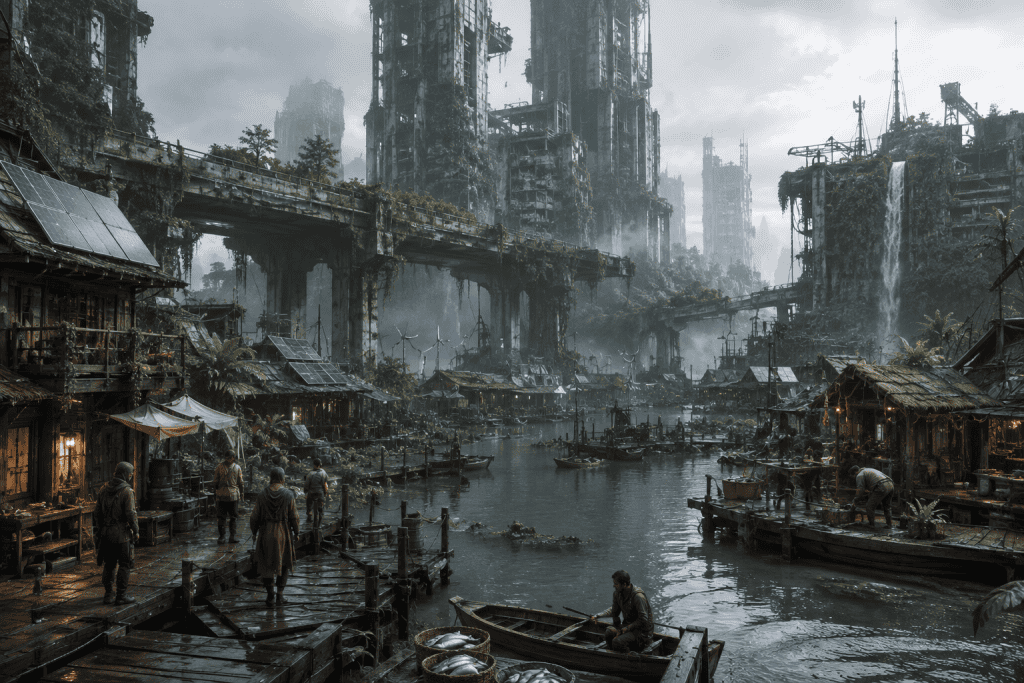
- Characteristics: Systemic collapse in the 21st or 22nd century (via climate cascades, unmanaged AI, or conflict) reduced technological capacity; by 3000, regional, low-energy societies inhabit an altered planet alongside high-tech ruins.
- Assumptions: Failure to manage existential technological and environmental risks.
- Probability: Moderate probability if systemic risks are mismanaged.
EXECUTIVE SUMMARY
The year 3000 CE represents a horizon forty generations removed from the present. Grounded in empirical physical constraints, this investigation demonstrates that Earth’s geography, biological boundaries, energy footprint, and technological infrastructure will undergo a structural shift. Whether humanity thrives as a multi-planetary post-biological species or persists in a carefully balanced planetary sanctuary depends on how civilization navigates the existential bottlenecks of the coming two centuries.
Conclusion: The World We Are Building Today
The year 3000 is ultimately a mirror reflecting our current choices. The physical geography of Earth in a thousand years—its sea levels, atmospheric stability, and biological richness—will be the direct consequence of contemporary environmental and technological stewardship. While technology, food, transit, and communication will become unrecognizable, the fundamental core of human nature—curiosity, love, storytelling, and the quest for meaning—will endure. If a traveler wakes up on Earth in 3000, they will stand on the foundation laid by the decisions we make today.
FREQUENTLY ASKED QUESTIONS (FAQ)
Q1: Will humans still exist in the year 3000?
Provided civilization navigates existential risks like climate tipping points, nuclear conflict, and unmanaged artificial intelligence, humanity will exist in 3000. However, through genetic engineering and bio-digital integration, ‘humanity’ will likely encompass a diverse family of biological and post-biological sub-species.
Q2: What will Earth’s climate look like in 3000?
Due to the multi-century atmospheric lifetime of carbon dioxide and deep-ocean thermal inertia, sea levels will commit to being 2 to 10+ meters higher. However, active planetary geoengineering and closed-loop carbon cycles will likely stabilize planetary temperatures over a millennial scale.
Q3: Will humans live on Mars or the Moon by 3000?
Yes. A thousand years provides ample time to build permanent, self-sustaining subsurface lava tube cities on the Moon and pressurized basin arcologies on Mars. However, due to extreme radiation and gravity differences, off-world communities will rely heavily on specialized bio-engineering and closed-loop habitats.
Q4: How advanced will artificial intelligence be in 3000?
AI will operate as the underlying infrastructure of global civilization—managing energy grids, resource allocation, climate arrays, and automated scientific discovery. Neural interfaces will allow direct cognitive integration between human minds and computational networks.
Q5: Will humans live longer in the year 3000?
Advances in cellular repair, gene editing, and nanomedicine will eliminate inherited diseases and extend healthy human lifespans to several centuries. The focus will shift from merely extending lifespan to expanding ‘healthspan’—maintaining peak cognitive and physical vitality.
Q6: Will money and traditional jobs still exist in 3000?
As energy abundance (via fusion and space solar) and robotics reduce the cost of basic physical necessities to near zero, traditional routine labor for subsistence will become obsolete. Economics will shift toward thermodynamic energy allocation, while human activity centers on science, art, philosophy, and community.
Sources & References
Archer, David. The Long Thaw: How Humans Are Changing the Next 100,000 Years of Earth’s Climate. Princeton University Press, 2009.
Clark, Peter U., et al. “Consequences of twenty-first-century policy for multi-millennial climate and sea-level change.” Nature Climate Change, vol. 6, no. 4, 2016, pp. 360-369.
Intergovernmental Panel on Climate Change (IPCC). Sixth Assessment Report: The Physical Science Basis. Cambridge University Press, 2021.
Bostrom, Nick. Superintelligence: Paths, Dangers, Strategies. Oxford University Press, 2014.
Smil, Vaclav. Energy and Civilization: A History. MIT Press, 2017.
O’Neill, Gerard K. The High Frontier: Human Colonies in Space. William Morrow & Co., 1977.
Chaisson, Eric J. Cosmic Evolution: The Rise of Complexity in Nature. Harvard University Press, 2001.
Doudna, Jennifer A., and Samuel H. Sternberg. A Crack in Creation: Gene Editing and the Unthinkable Power to Control Evolution. Houghton Mifflin Harcourt, 2017.