How ecological control, administrative innovation, and ideological statecraft built history’s most enduring civilization.
When European travelers stood before the Giza pyramids in the early nineteenth century, they confronted a phenomenon that defied their historical imagination: structures so massive and ancient that their origins seemed disconnected from human agency. The immediate impulse was to explain them through romantic myth, divine intervention, or brutal tyranny. Yet the reality behind these stone monuments is far more impressive. The durability of ancient Egypt was not an accident of geographical isolation, nor was it built on the backs of an enslaved workforce driven by the whip. It was the deliberate, sophisticated creation of a state apparatus that learned to harness an ecology, institutionalize administrative control, and project political authority across three millennia.
To understand pharaonic Egypt is to understand how a society transforms environmental vulnerability into an engine of institutional longevity. Between the unification of the dual lands around 3100 BCE and the death of Cleopatra in 30 BCE, the civilization along the Nile developed systems of governance, resource redistribution, and material engineering that outlasted every contemporary state in the Near East. By examining the mechanisms of this ancient super-state—its ecological foundations, its bureaucratic machinery, its strategic adaptation to crisis, and its scientific contributions—we reveal the underlying blueprint of human organizational power.
The Ecology of the Dual Land
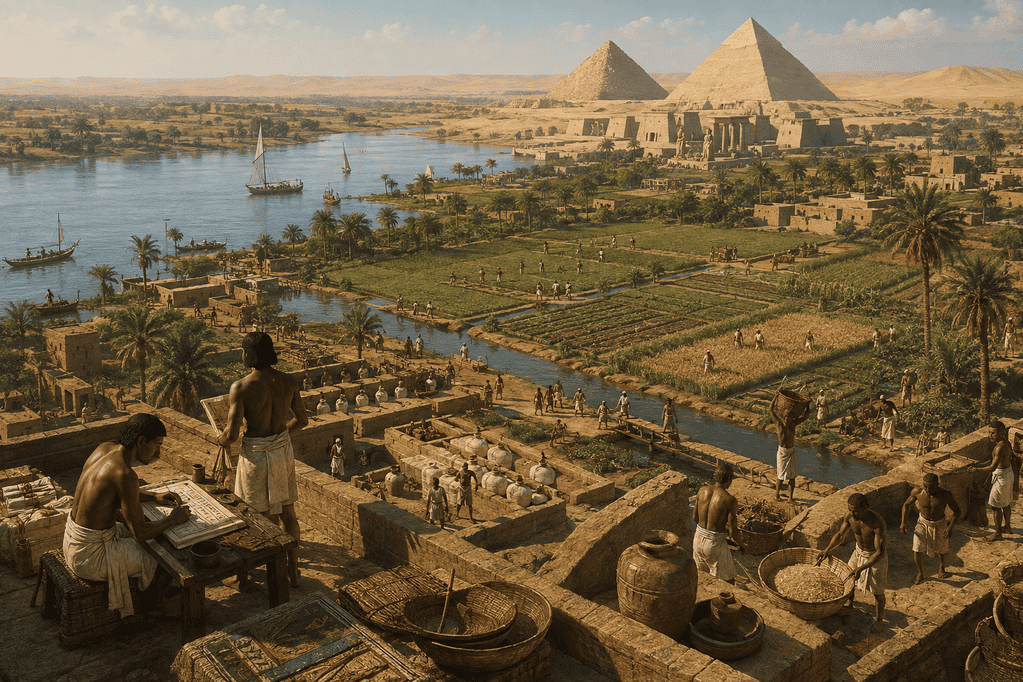
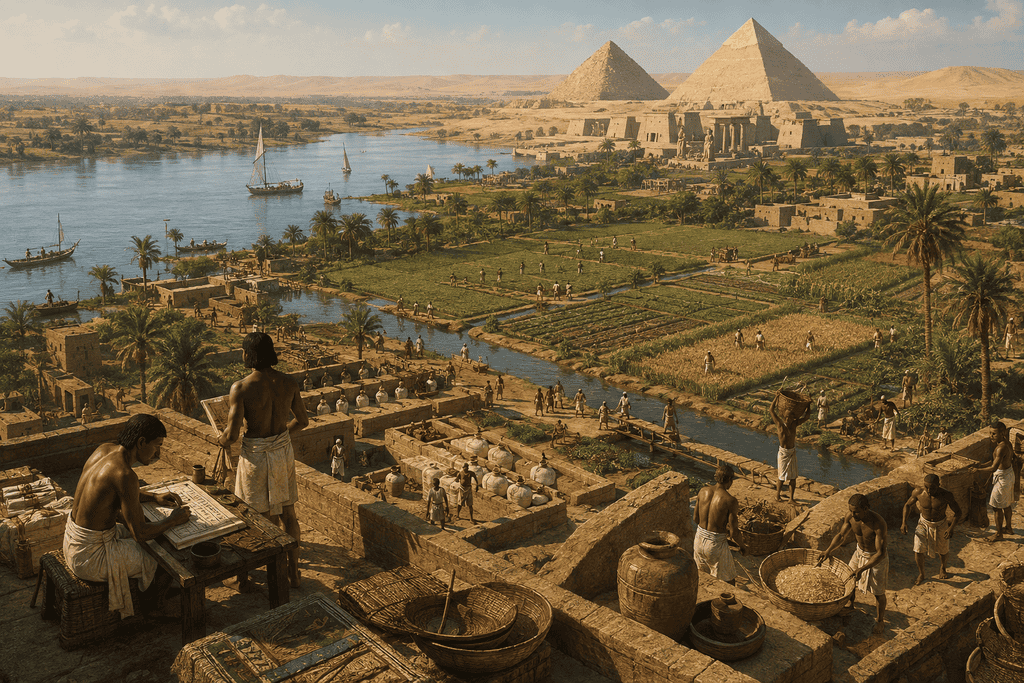
The Egyptian state emerged at the intersection of a hyper-predictable ecological engine and an absolute geographical boundary. Unlike the alluvial plains of Mesopotamia, where the Tigris and Euphrates cut unpredictable, destructive paths across open terrain, the Nile River valley provided a narrow corridor of astonishing agricultural abundance wrapped in impassable desert. This stark environmental reality shaped every aspect of Egyptian thought, dividing the world into two distinct domains: Kemet, the fertile “Black Land” covered in rich river silt, and Deshret, the barren “Red Land” of the surrounding desert.
Each summer, driven by monsoon rains in the Ethiopian highlands, the Nile overflowed its banks in a predictable inundation known as Akhet. As the floodwaters receded, they left behind a deep layer of nutrient-dense silt that allowed crops to flourish with minimal labor compared to other ancient agricultural regions. Yet converting this natural flood into sustained state power required complex human organization. Basin irrigation required seasonal labor, precise field surveying after the water retreated, and massive grain storage facilities to guard against lean years.
The unification of Upper and Lower Egypt under a single sovereign—traditionally attributed to King Narmer around 3100 BCE—was the political consolidation of this ecological imperative. A single ruler governing the entire length of the river could coordinate water management across regional boundaries, ensure the free movement of trade, and mobilize agricultural surplus on a national scale.
To legitimate this immense central authority, the state developed a powerful ideological framework centered on the concept of Ma’at. Representing cosmic balance, truth, justice, and order, Ma’at was the fundamental force that kept chaos—Isfet—from consuming the world. The pharaoh was not merely a political executive, but a divine intermediary, an earthly incarnation of Horus and the son of Ra. The king’s primary duty was the maintenance of Ma’at. If the Nile failed to flood, or flooded too violently, it was interpreted not merely as an engineering failure, but as a dangerous rupture in the cosmic order that threatened the survival of the state itself.
The Cycle of Collapse and Adaptation
The three-thousand-year trajectory of pharaonic history was not a static, uninterrupted monologue. Instead, it unfolded as a dramatic cycle of strong central authority interrupted by environmental shocks, political fragmentation, and foreign intrusion. The state’s true genius lay in its ability to adapt its institutional structures after every period of collapse.
During the Old Kingdom (c. 2686–2181 BCE), the template for absolute divine kingship reached its apex. The state demonstrated its capacity to organize national labor by constructing the monumental pyramid complexes at Saqqara and Giza. Power was concentrated heavily in the royal court at Memphis, supported by an economy that collected agricultural yields centrally and redistributed them to workers, craftsmen, and provincial administrators.
This rigid concentration of authority proved vulnerable when environmental conditions changed. Around 2200 BCE, a global shift in climate patterns brought a prolonged megadrought to northeastern Africa, causing a succession of dangerously low Nile floods. When the central government could no longer guarantee food security, its divine legitimacy evaporated. Regional governors, known as nomarchs, stepped into the power vacuum to secure food for their local populations. The Old Kingdom fractured into the First Intermediate Period, a chaotic era marked by civil conflict, economic distress, and regional warlordism.
Reunification came under Mentuhotep II, inaugurating the Middle Kingdom (c. 2055–1650 BCE), an era that fundamentally reshaped the philosophy of Egyptian governance. Shaken by the memory of state collapse, the literature and royal portraiture of this period abandoned the distant, invincible facade of the Old Kingdom. Pharaohs were depicted with worried brows and heavy eyes—watchful shepherds accountable for their people’s welfare. The administration expanded its bureaucratic reach, invested heavily in massive land-reclamation projects in the Faiyum oasis, and elevated the scribal profession into a dominant administrative class.
This refined political machinery faced an unprecedented shock during the Second Intermediate Period, when Levantine settlers known as the Hyksos gained control of the Nile Delta. Equipped with superior military technologies—including composite bows, horse-drawn chariots, and advanced bronze weaponry—the Hyksos ruled Lower Egypt for over a century. Rather than destroying the state, the Hyksos experience transformed it. Upon expelling the foreign rulers, Ahmose I launched the New Kingdom (c. 1550–1070 BCE), turning a previously isolationist agrarian society into an aggressive, militarized empire. Egyptian armies marched north to the Euphrates and south deep into Nubia, establishing vast trade networks and institutionalizing international diplomacy through formal royal correspondence.
Logistics, Labor, and the Scribe
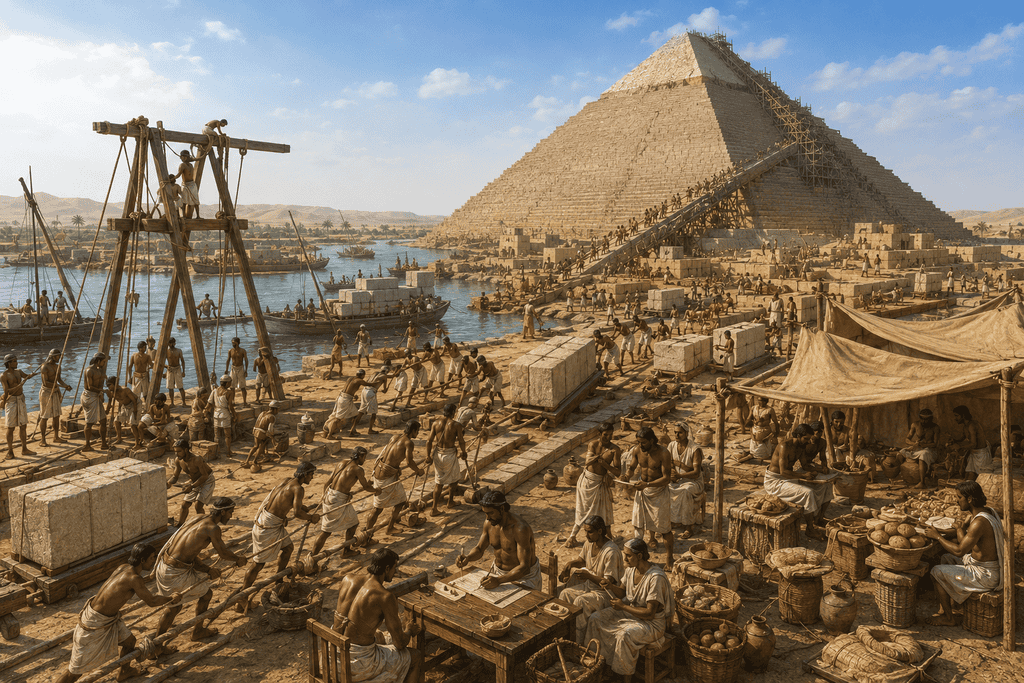
For centuries, popular imagination held that Egypt’s monumental achievements were extracted through the brutal exploitation of millions of enslaved workers. Decades of modern archaeological investigation have dismantled this myth, revealing instead a highly organized system of state-administered public works powered by paid, rotation-based civic labor.
Excavations led by Mark Lehner at Heit el-Ghurab—the “Lost City of the Pyramids” at Giza—have uncovered the infrastructure required to support the workforce that built the Great Pyramid. The site revealed massive dormitories, bakeries capable of producing thousands of loaves daily, and animal bone deposits showing that workers were fed high-grade cattle, sheep, and goat meat. This was not a prison camp; it was an industrial settlement designed to nourish a highly organized construction force.
During the summer months, when the Nile flooded the fields and rendered agricultural work impossible, the state mobilized farmers through the corvée system—a national service obligation. Citizens performed labor as a form of taxation, receiving food, clothing, shelter, and medical care in return. Far from being a burden that destroyed society, these massive infrastructure projects functioned as economic engines. They redistributed stored grain reserves during non-harvest months, integrated regional populations into a unified national identity, and reinforced allegiance to the central crown.
This massive logistical machinery was directed by a tiny, highly privileged minority: the scribal class. Literacy in ancient Egypt was restricted to an estimated one to two percent of the population, making the ability to read and write the ultimate key to political power. Scribes calculated crop yields, surveyed land boundaries after floods, calculated tax obligations, managed army supply lines, and directed the movement of building materials.
The administrative sophistication of this system was confirmed in 2013 by the discovery of the Diary of Merer at the ancient Red Sea port of Wadi al-Jarf. Written on papyrus by a middle-level inspector named Merer, this logbook details the daily activities of an elite crew of forty workers during the reign of Khufu. Merer records how his men managed stone transport, opened canal gates, and navigated heavy wooden barges carrying high-grade Tura limestone down the Nile directly to the Giza plateau. The diary reveals a bureaucracy operating with clear chains of command, meticulous record-keeping, and extraordinary operational efficiency.
Ideology and the Amarna Interlude
The institutional stability of the Egyptian state relied on a delicate balance between the royal court and the powerful priesthoods that managed the country’s vast temple networks. Temples were not merely religious sanctuaries; they were major economic hubs holding extensive agricultural land, livestock, granaries, and workshops. Over generations, the priesthood of Amun at Thebes accumulated immense wealth and political influence, eventually rivaling the authority of the pharaoh himself.
This power dynamic culminated in one of the most radical political experiments in ancient history during the reign of Amenhotep IV, who renamed himself Akhenaten (c. 1353–1336 BCE). Akhenaten abolished the traditional pantheon of gods, closed the temples of Amun, dismantled the established priesthoods, and relocated the national capital to a pristine site in middle Egypt named Akhetaten (modern Amarna). He declared that the Aten—the physical solar disc—was the sole god, and that he and his queen, Nefertiti, were its only direct intermediaries.
Historians continue to debate whether the Amarna period represented a genuine theological revolution toward monotheism or a ruthless political purge designed to destroy the Amun priesthood. The evidence points to a combination of both. By stripping the traditional temples of their wealth and redirecting land revenue straight to the royal treasury, Akhenaten temporarily reasserted absolute royal dominance.
Yet the experiment fundamentally misunderstood the deep-seated cultural role of Ma’at. By outlawing traditional deities, the state alienated the general population and disrupted the local economic networks tied to regional temples. Shortly after Akhenaten’s death, his young successor, Tutankhamun, abandoned the new capital, restored the old gods, and reinstated the priesthoods. The state’s administrative apparatus digested the radical rupture, erased Akhenaten’s name from official monuments, and restored the ideological equilibrium necessary for imperial stability.
Science, Medicine, and Cultural Legacy
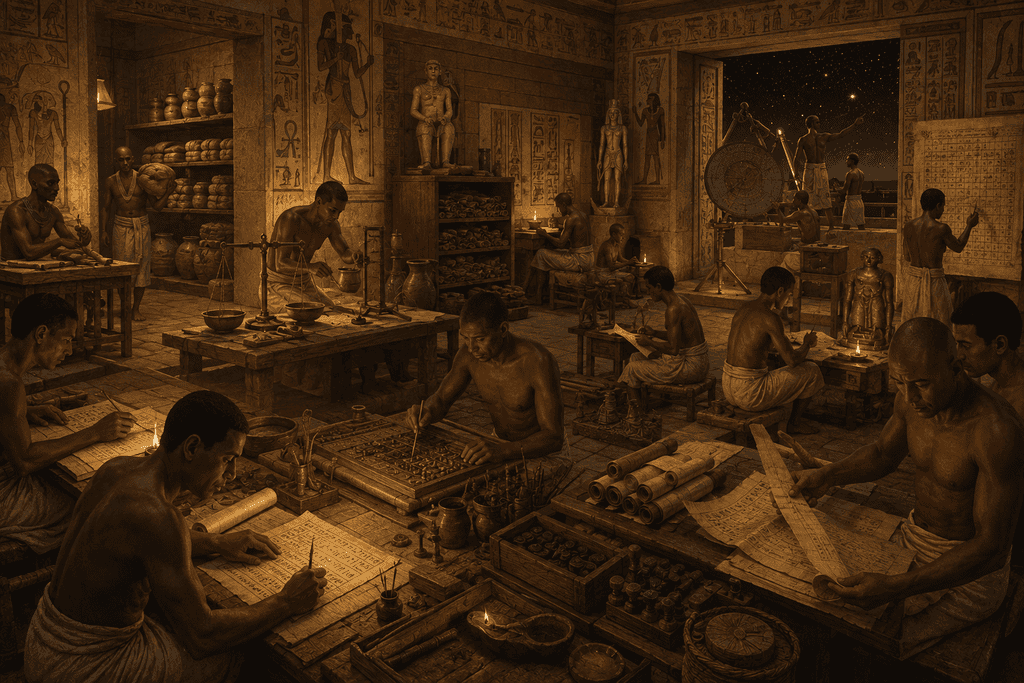
The institutional longevity of ancient Egypt allowed empirical knowledge to accumulate, crystallize, and pass down over generations. Rather than remaining isolated within the Nile Valley, Egyptian innovations in science, architecture, and mathematics formed the foundational substrate of broader Mediterranean civilization.
In medicine, Egyptian practitioners shifted early from magical incantations to systematic clinical observation. Papyri such as the Edwin Smith Papyrus, dating to around 1600 BCE, reveal a structured approach to trauma surgery. The text organizes medical cases logically: examining physical symptoms, establishing a formal diagnosis, offering a prognosis, and outlining specific treatments for head injuries, spinal trauma, and bone fractures. This empirical methodology deeply influenced early Greek medical traditions, providing a conceptual bridge to modern clinical practice.
Egyptian builders similarly revolutionized civil engineering by mastering cut-stone masonry on a monumental scale. Before the Third Dynasty architect Imhotep designed the Step Pyramid complex for King Djoser at Saqqara, royal tombs were constructed primarily of short-lived mudbrick. Imhotep recognized that stone could grant eternal permanence to state architecture. The structural forms developed in Egyptian hypostyle halls—featuring massive stone columns topped with stylized papyrus and lotus capitals—directly inspired early archaic Greek architecture, providing the structural prototype for the classical orders of the Mediterranean world.
Practical astronomy and timekeeping were similarly refined to serve administrative needs. To predict the exact onset of the Nile inundation, Egyptian astronomers tracked the heliacal rising of Sirius—the star Sothis—when it first appeared on the eastern horizon just before sunrise. From these observations, they engineered a 365-day solar calendar comprising twelve months of thirty days each, supplemented by five intercalary festival days at the end of the year. Century after century, this calendar governed administrative tax cycles and agricultural labor. Millennia later, Julius Caesar, aided by the Alexandrian astronomer Sosigenes, adapted this Egyptian solar tracking system into the Julian calendar, establishing the structural baseline for the modern calendar used globally today.
The Lessons of Permanence
When the last hieroglyphic inscription was carved at the temple of Philae in 394 CE, the political system of the pharaohs had already yielded to Roman rule. Yet the institutional blueprint created along the Nile never truly disappeared. Ancient Egypt proved that state survival over deep time depends on aligning administrative infrastructure with ecological realities, balancing centralized authority with institutional adaptability, and building economic systems that invest surplus back into civic cohesion.
By transforming an unpredictable river valley into a structured engine of wealth, engineering, and scientific enquiry, the ancient Egyptians built more than stone tombs. They demonstrated the upper limits of human organizational capacity, leaving behind a legacy that continues to define our understanding of statecraft, architecture, and the search for permanence in an uncertain world.