How a West African rainforest empire engineered the world’s largest earthworks, mastered advanced metallurgy, and defied European power for centuries before a forgotten war dismantled its capital.
The Fortress of Brass and Earth
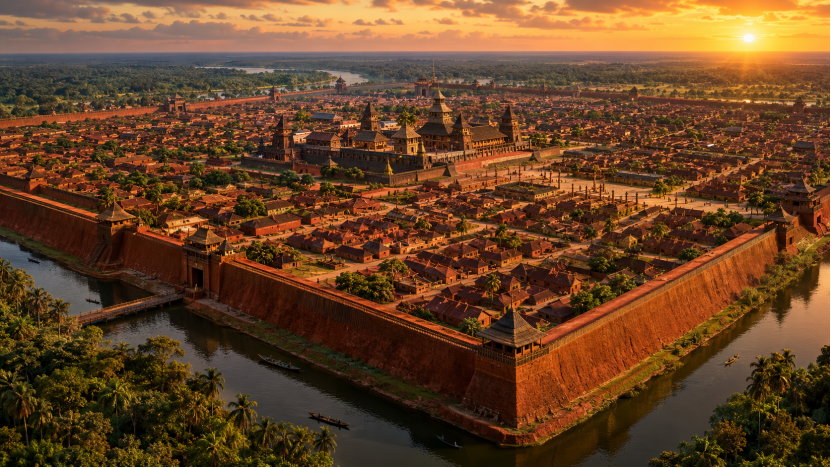
When the Dutch geographer Olfert Dapper compiled descriptions of West Africa in 1668, European visitors to Benin City described an urban landscape that upended Continental assumptions. Dapper recounted a metropolis designed on a grand scale, featuring broad avenues, systematic street networks, and a royal palace complex that matched the size of small European cities.
Yet, little over two centuries later, British colonial accounts framed this same state as a place of dark, lawless chaos requiring imperial intervention. In 1897, a British military expedition invaded the kingdom, burned its capital, exiled its sovereign, and stripped its royal palaces of thousands of brass reliefs, ivories, and sacred sculptures.
This stark transformation raises fundamental questions about one of Africa’s most formidable pre-colonial states. How did an empire situated in the dense tropical rainforest of the Niger River basin build urban infrastructure that rivaled contemporary European cities? What economic and political structures sustained its sovereignty for nearly a millennium? And how did its legacy come to be systematically dismantled at the end of the nineteenth century?
The Pre-Colonial Foundations
The political evolution of Benin unfolded in two distinct dynastic eras within the dense tropical forests of present-day southern Nigeria.
The earliest organized state in the region, known as Igodomigodo, was ruled by a line of thirty-one monarchs called the Ogiso, or “Kings of the Sky,” from roughly the tenth through the mid-twelfth centuries. During this initial phase, power was relatively decentralized. The Ogiso governed alongside a council of elders and localized chiefs who managed autonomous rural settlements across the forest belt.
By the mid-twelfth century, internal dynastic rivalries, administrative mismanagement, and popular unrest brought the Ogiso line to an end. Fearing political collapse, Edo leaders sought a unifying figure to restore stability. They turned to the sacred spiritual center of Ile-Ife, requesting a prince to guide their state.
Prince Oranmiyan was dispatched from Ife, but finding the local political factionalism difficult to navigate, he ultimately departed. However, his son, born to an Edo noblewoman, was raised within the society and crowned as Eweka I around 1200 CE. Eweka became the first Oba, or King, of Benin. By merging divine legitimization from Ife with native Edo governance traditions, Eweka established a royal line that continues to exercise profound cultural authority today.
The Golden Age of the Warrior Kings
Benin’s transformation from a regional forest state into an expansive empire occurred during the fifteenth and sixteenth centuries, driven by a sequence of highly effective rulers.
The pivotal architect of this expansion was Oba Ewuare the Great, who reigned from 1440 to 1473. Ewuare executed a comprehensive restructuring of the state’s political and physical infrastructure. To curb the influence of hereditary kingmakers known as the Uzama, he created new orders of palace and town chiefs directly dependent on the crown. He rebuilt the capital, implementing a structured layout of wide avenues and organized residential quarters. He also initiated the royal tradition of elaborate coral-bead regalia and renamed the state Edo.
Ewuare was succeeded by a line of strategic military commanders. Oba Ozolua, who took power in the late fifteenth century, led dozens of military campaigns, expanding the empire’s influence across the Niger Delta and into the Yoruba hinterlands.
In the early sixteenth century, Oba Esigie further consolidated the realm through diplomacy, intellect, and administrative reform. Esigie learned Portuguese, established direct diplomatic relations with King John II of Portugal, and oversaw a major economic expansion driven by pepper and ivory exports. Recognizing the political acumen of his mother, Idia, whose strategic counsel was instrumental during a major war with the neighboring Igala kingdom, Esigie created the official title of Iyoba, or Queen Mother, establishing a influential political office that remains a cornerstone of the monarchy.
Engineering the Earth and Casting the Brass
The sophistication of the Kingdom of Benin was demonstrated most clearly in its monumental urban engineering and highly organized metallurgical production.
Surrounding Benin City was a vast network of linear earthworks, a system of interconnected ramparts and ditches known as the Walls of Benin. Archaeological mapping reveals that this network stretched for thousands of kilometers across the countryside, enclosing thousands of square kilometers. In terms of total excavated earthwork volume, the network represents one of the largest continuous civil engineering projects in human history.
Unlike European fortifications designed exclusively to withstand heavy siege artillery, these earthworks served multiple functions. They defined urban boundaries, delineated agricultural territories, regulated internal migration, and channeled trade traffic through controlled, fortified gateways where state tolls were collected.
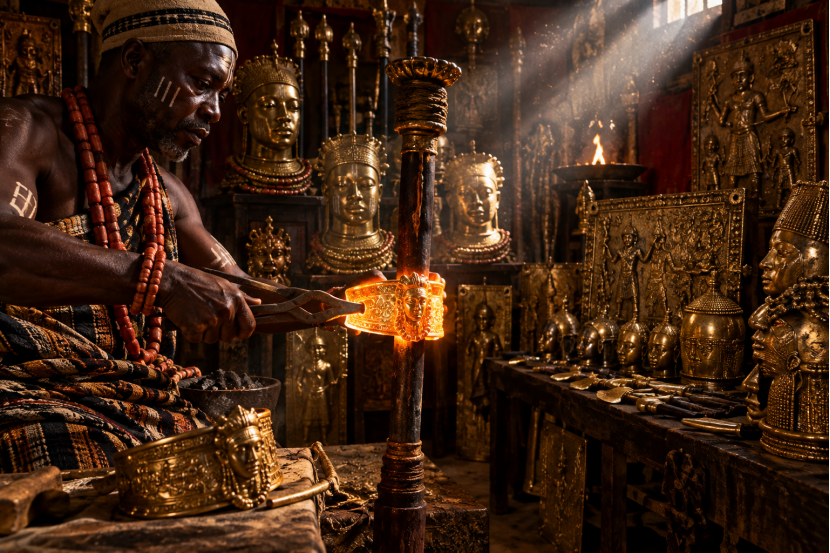
Complementing this physical infrastructure was the kingdom’s mastery of metalworking. The famous “Benin Bronzes” primarily brass sculptures, relief plaques, and carved ivory tusks were created using the lost-wax casting technique (cire perdue). This delicate process involved sculpting a precise wax model over a fire-resistant clay core, encasing it in layers of fine liquid clay, melting away the wax, and pouring molten brass into the resulting void. The technical perfection of these castings equaled or exceeded the finest metallurgy produced in Renaissance Europe.
Production was strictly regulated by the state through the Igun Eronmwon, a specialized, hereditary guild of master artisans operating in a designated quarter of the capital under royal command. These metalworks fulfilled vital institutional roles:
Historical Documentation: Cast relief plaques mounted on the timber pillars of the royal palace served as a visual archive, recording military victories, diplomatic missions, court rituals, and political hierarchies.
Ancestral Veneration: Sculpted brass heads held intricately carved elephant tusks, resting on royal altars dedicated to former Obas.
Royal Authority: Pectoral masks, hip ornaments, and decorative armlets functioned as sacred symbols of delegated authority for high-ranking chiefs and state envoys.
State Monopoly and the Atlantic Economy
Benin maintained strict centralized control over its foreign trade, operating a state-monopolized commercial model that allowed it to engage with European powers on its own terms for centuries.
When Portuguese traders arrived on the West African coast in the late fifteenth century, the crown strictly restricted their movements. European merchants were not permitted to freely traverse the interior; instead, all transactions were conducted at designated coastal outposts under the supervision of royal officials known as the Iwebo chiefs.
The empire carefully selected its exports, trading malagueta pepper, high-quality woven textiles, palm oil, and elephant ivory in exchange for raw copper, brass ingots, coral beads, cowrie shells, and luxury goods.
Crucially, during the early sixteenth century, Oba Esigie implemented a strict ban on the export of male captives from the kingdom. Recognizing that losing its working population would undermine its agricultural foundation and military capability, Benin preserved its manpower, focusing its trade strategy on raw materials and manufactured goods. Large quantities of European brass ingots, imported in the form of ring-shaped manillas, were melted down by the state’s artisan guilds to forge royal monuments and historical archives.
The Road to the 1897 Invasion
By the late nineteenth century, the geopolitical dynamics of West Africa were rapidly shifting as European industrial nations sought direct control over African raw materials.
British merchant cartels and colonial administrators in the Niger Coast Protectorate grew increasingly frustrated by Oba Ovonramwen’s insistence on maintaining royal trade monopolies over palm oil and rubber. The crown refused to sign treaties that would cede sovereignty or allow unhindered foreign commercial access to the interior.
The diplomatic impasse reached a crisis in January 1897. Acting Consul-General James Phillips led an unauthorized, armed expedition of British officers and African porters toward Benin City, despite explicit warnings from the Oba that the capital was closed during the sacred Ague festival. Concerned that the advancing column posed an immediate military threat, senior Benin military chiefs ambushed the party at Ughoton, killing Phillips and most of his delegation.
The response from London was immediate. In February 1897, the British Admiralty dispatched a naval brigade of 1,200 troops equipped with Maxim machine guns, heavy artillery, and rocket tubes under the command of Rear-Admiral Harry Rawson.
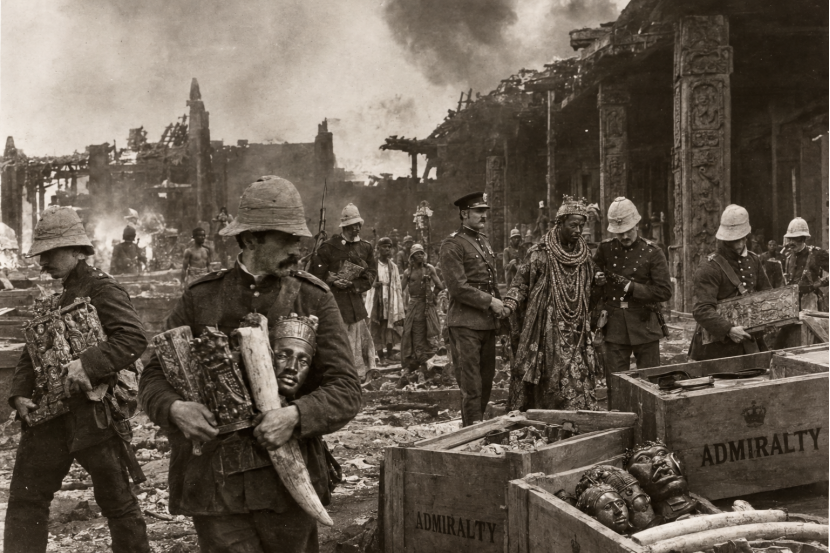
After ten days of intense fighting through the rainforest, British forces breached the capital. The royal palace was looted and set ablaze, sacred ancestral shrines were desecrated, and Oba Ovonramwen was captured, tried, and exiled to Calabar, where he died in 1914.
During the occupation, British forces systematically stripped the royal complex and state buildings of more than ten thousand works of art. These treasures were brought to London and auctioned by the Foreign Office and Admiralty to offset the financial costs of the military campaign, dispersing them into public museums and private collections across Europe and North America.
The Struggle for Restitution and Legacy
The fall of Benin in 1897 dismantled an independent state, but it did not erase its culture or institutions. The Edo monarchy was restored in 1914 under Oba Eweka II, and the Royal Court continues to serve as an important cultural and spiritual center in modern Nigeria.
Today, the looted Benin Bronzes sit at the center of the global debate over cultural heritage, imperial plunder, and restitution. For decades, major Western cultural institutions resisted returning these works, offering arguments about international stewardship.
However, intense ethical pressure, diplomatic engagement, and scholarly research have transformed the conversation. In recent years, governments and institutions in Germany, the United Kingdom, and the United States have formally transferred legal ownership of hundreds of looted artifacts back to Nigeria and the Royal Court of Benin.
The history of Benin refutes long-standing colonial myths that presented pre-colonial West Africa as lacking urban planning, advanced technology, or complex governance. Through its monumental earthworks, sophisticated metallurgy, and resilient political structure, the Kingdom of Benin built one of the world’s most impressive forest empires, a legacy that continues to reshape our understanding of African history today.