At its height, West Africa’s greatest empire ruled over an area larger than Western Europe. Then a four-thousand-man mercenary army marched across the Sahara and destroyed it in an afternoon.
On a dry morning in March 1591, near the small settlement of Tondibi along the northern bend of the Niger River, two irreconcilable visions of warfare stood facing one another across the scrubland. On one side was the imperial army of Songhai: roughly thirty thousand cavalry and infantry drawn from across the vast interior of West Africa, fighting under the banners of Askia Ishaq II. They represented the dominant superpower of the Western Sudan, a state that had spent more than a century consolidating its hold over the rich river valleys, goldfields, and trans-Saharan trade routes between the Atlantic Ocean and the central Sahara.
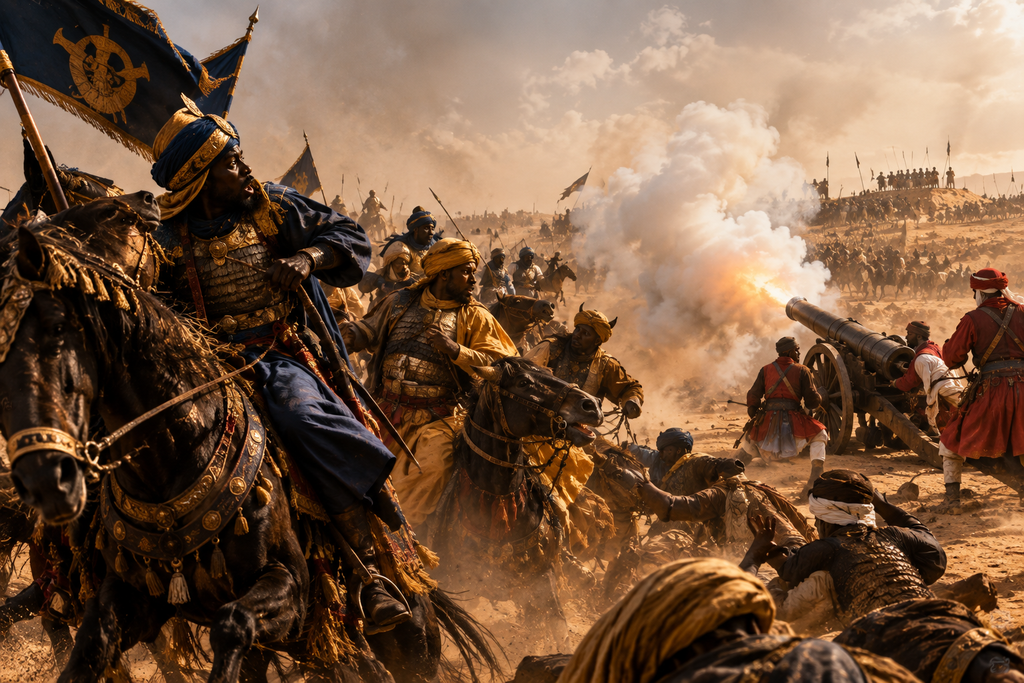
On the other side stood an improbable expeditionary force sent by Sultan Ahmad al-Mansur of Morocco. Commanded by Judar Pasha, a Spanish-born eunuch in the service of the Saadi dynasty, this four-thousand-man force had just completed an agonizing, twenty-week march across two thousand miles of open desert. They were vastly outnumbered, exhausted, and operating thousands of miles from their supply bases. But they brought with them a technological novelty that the armies of the Niger valley had never encountered on a battle scale: the matchlock arquebus and early field artillery.
Desperate to break the Moroccan lines without charging directly into gunfire, the Songhai command devised a pragmatic solution. They gathered a herd of one thousand cattle and drove them ahead of their frontline infantry, intending to use the animals as a living shield to absorb the shock of battle and trample the enemy’s ranks.
The strategy failed completely. As the Moroccan line unleashed its first coordinated volley, the sudden thunder of black powder and the blinding clouds of acrid smoke panicked the herd. The cattle pivoted sharply, driving back into the dense ranks of the Songhai infantry behind them. In the ensuing chaos, the Moroccan gunpowder units advanced with methodical discipline. Within hours, the Songhai military was broken, Askia Ishaq II was in full retreat, and the administrative state that had organized West Africa’s economic and intellectual life for generations began to collapse.
Yet the catastrophe at Tondibi was not simply a story of military technology. The sudden fall of the Songhai Empire was the culmination of internal political decay, structural succession crises, and a shifting global economy that was quietly moving the center of international commerce away from the desert caravans and toward the Atlantic coast.
The Highway of the Western Sudan
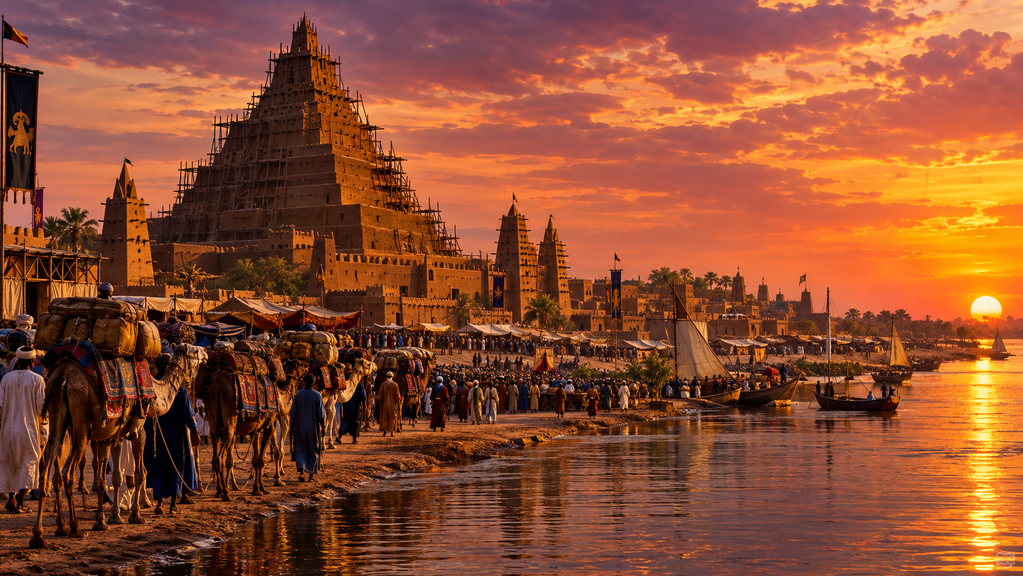
To understand how Songhai reached such heights, one must look to the unique geography of the Niger River. Unlike the dense rainforests to the south or the arid expanse of the Sahara to the north, the middle Niger formed an inland waterway through the Sahel. It functioned as both an agricultural sanctuary and a natural highway, allowing people, grain, and trade goods to move across vast distances with relative ease.
For centuries, the settlement of Gao, located along the eastern bend of the river, had operated as a crucial commercial intersection. Here, riverborne grain and fish met the trans-Saharan caravans carrying salt, textiles, horses, and books from Mediterranean ports. By the ninth century, the Za dynasty had established Gao as a localized power, eventually converting to Islam to strengthen political and economic ties with North African merchant networks.
For generations, Gao remained a minor power compared to its western neighbors, the Ghana Empire and later the imperial state of Mali. When the legendary Mali ruler Mansa Musa expanded his territory in the early fourteenth century, he annexed Gao, integrating its river trade into his empire. But as internal rivalries and succession disputes weakened Mali toward the end of the century, the rulers of Gao saw an opportunity to break free.
The transformation of Songhai from a riverine kingdom into a formidable empire began with the ascension of Sonni Ali in 1464. Known to later chroniclers as Ali Ber, or “Ali the Great,” he was primarily a military strategist who spent his twenty-eight-year reign almost entirely in the field.
Sonni Ali realized that controlling the Sahel required dominance over the Niger River itself. He constructed a fleet of armored war canoes crewed by the river-dwelling Bozo people, transforming the river into a logistics network for fast troop movements. Operating with relentless speed, he captured the commercial hub of Timbuktu from the Tuareg in 1468 and conquered the inland delta market of Djenné in 1473 after a siege that lasted several years. By unifying the three great urban centers of the middle Niger—Gao, Timbuktu, and Djenné—Sonni Ali built a new imperial power over the ruins of the declining Mali Empire.
The Askia Revolution
Sonni Ali’s death in 1492 triggered a deep ideological crisis. While Ali had been a pragmatic ruler who balanced the animist traditions of his rural soldiers with the Islamic expectations of urban merchants, his successor, Sonni Baru, aligned himself firmly with the traditionalist rural elite. This decision alienated the wealthy Muslim merchant class and scholar networks of Timbuktu, who demanded a government rooted in Islamic law and predictable administration.
Recognizing the shift in power, Muhammad Ture, one of Sonni Ali’s senior military generals, led a rebellion against Sonni Baru. In 1493, Muhammad Ture defeated the last Sonni ruler at the Battle of Anfao and claimed the throne, founding the Askia Dynasty.
Where Sonni Ali had ruled through personal authority and continuous military campaigns, Askia Muhammad I turned Songhai into an institutionalized administrative state. Recognizing that a vast empire could not be governed by military force alone, he created a centralized bureaucracy that managed imperial affairs through distinct structural innovations:
Provincial Governance: He replaced semi-independent hereditary chiefs with appointed imperial governors, known as Farmas or Mondzos, who managed provinces and reported directly to the central court at Gao.
Specialized Ministries: The state created dedicated administrative posts, including the Hi-koy (admiral of the imperial river fleet), the Fari-mundyo (chief inspector of weights, measures, and tax collection), and judicial officers across major urban centers.
Economic Standardization: He standardized weights and measures across the empire’s markets, bringing consistency to commercial transactions and streamlining tax collection on agricultural yields and trade goods.
International Legitimacy: In 1496, Askia Muhammad undertook a lavish pilgrimage to Mecca, returning with the official title of Caliph of the Western Sudan, granted by the Sharif of Mecca. This designation elevated his standing across the Islamic world and secured trade connections with North Africa and the Middle East.
Under Askia Muhammad’s thirty-five-year reign, Songhai expanded its borders until it covered more than 1.4 million square kilometers, stretching from the Atlantic coast of modern Senegal eastward into parts of present-day Niger and Nigeria.
Gold, Salt, and Manuscripts
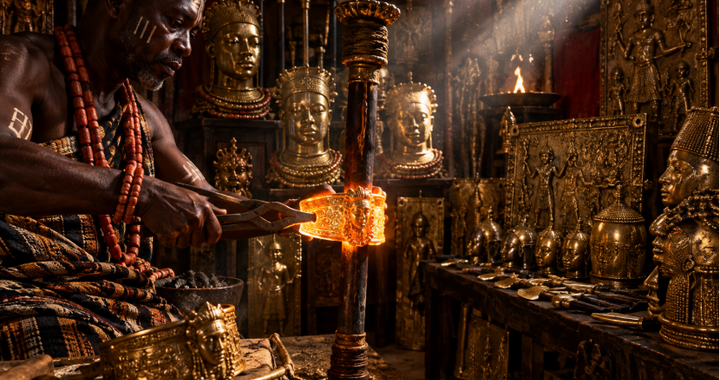
At its height in the sixteenth century, the Songhai Empire operated as the primary financial engine of West Africa, deriving its wealth from a complex three-tier economic structure: rural agriculture, long-distance trans-Saharan trade, and urban intellectual production.
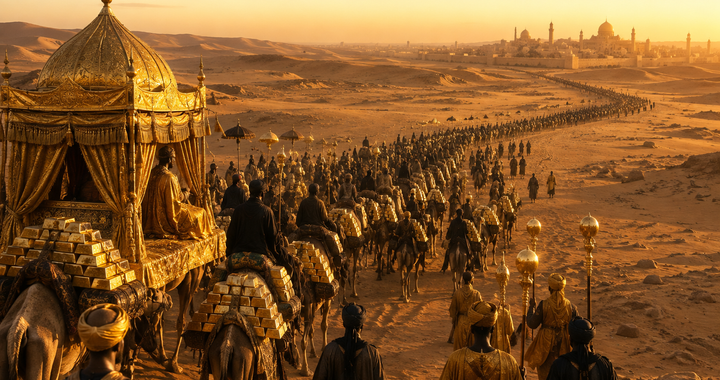
The imperial economy relied on a trade imbalance between two essential resources: salt and gold. From the deep Sahara, mined slabs of rock salt from Taghaza were carried south by vast camel caravans. In the tropical regions to the south, salt was vital for survival and commanded a premium price, often traded weight-for-weight for alluvial gold extracted from the rich southern river basins of Bambuk, Bure, and the Akan hinterlands.
The empire sat directly at the center of this exchange, levying strict import and export duties on every load of salt, gold, textiles, and copper that crossed its borders. Mediterranean goods and North African horses moved south through the desert networks, while raw wealth and luxury commodities flowed back north.

In cities like Timbuktu and Djenné, this commercial wealth funded a flourishing academic enterprise. The University of Sankoré, an informal collection of madrasas centered around the Sankoré Mosque, hosted an estimated twenty-five thousand scholars and students. Supported by royal grants, commercial patrons, and a thriving manuscript trade, Timbuktu became a major hub for international scholarship. Imported Arabic manuscripts on theology, Maliki jurisprudence, astronomy, mathematics, and medicine frequently fetched higher prices in local markets than luxury textiles or imported horses.
Local chroniclers such as Abd al-Rahman al-Sadi, author of the Tarikh al-Sudan, and Mahmud Kati, credited with the Tarikh al-Fattash, produced detailed historical narratives that documented the political, legal, and intellectual life of the empire, leaving behind a rich written archive of pre-colonial West Africa.
Structural Fractures Within
Despite its apparent wealth and military reach, sixteenth-century Songhai carried deep structural vulnerabilities that eroded its stability from within.
The most profound internal division was the divide between the urban elite and the rural population. The cities of Gao, Timbuktu, and Djenné were cosmopolitan centers populated by Muslim merchants, administrative officials, and scholars. But the vast majority of the empire’s population lived in rural agricultural communities, practicing traditional indigenous faiths and forming the primary tax base of the state.
Where Sonni Ali had maintained stability through political pragmatism, the Askia Dynasty’s close alignment with urban Islamic elites gradually alienated rural populations. When external crises hit, these rural agrarian groups saw little reason to risk their lives to defend an imperial administration that taxed their harvests without offering meaningful political representation.
An even more immediate threat was the absence of a clear rule for royal succession. The empire never established a fixed system of primogeniture or a formal council to manage transitions of power. Consequently, almost every death of an Askia triggered a succession crisis, prompting urban factions and provincial governors to mobilize regional troops in bids for the throne.
Askia Muhammad I himself was deposed in 1528 by his eldest son, Askia Musa, initiating a period of domestic turmoil. Between 1528 and 1591, Songhai was ruled by eight different emperors, many of whom came to power through political assassinations, court intrigue, or open civil war.
A particularly damaging civil war broke out in 1588 between Askia El-Hajj and his rival Ishaq II. The conflict pitted regional garrisons against one another, resulting in the deaths of thousands of veteran cavalrymen, depleting the imperial treasury, and leaving the army severely weakened just three years before the Moroccan expedition arrived.
At the same time, the broader geopolitical environment was shifting against the empire. Since the late fifteenth century, European trading vessels had been establishing permanent posts along the Gulf of Guinea. As gold and other valuable trade goods began moving south toward coastal ports to meet European ships, the traditional trans-Saharan caravan routes lost their exclusive monopoly on West African trade, reducing the revenues that nourished the imperial administration at Gao.
The Moroccan Gambit and the Unraveling
In Marrakesh, Sultan Ahmad al-Mansur monitored these developments closely. Facing financial pressures from his own campaigns in North Africa and eager to secure a direct source of gold to stabilize his currency, al-Mansur turned his attention south toward the Sahara. He calculated that if a small, disciplined force equipped with modern firearms could cross the desert, it could capture the salt mines of Taghaza and seize control of the West African gold trade.
The march across the Sahara was a logistical gamble that cost the lives of hundreds of soldiers before they ever saw a battlefield. But Judar Pasha’s arrival at the Niger River in early 1591 caught the Songhai court unprepared. Rather than drawing the Moroccan forces into a prolonged war of attrition—cutting their supply lines across the desert or utilizing amphibious river tactics—Askia Ishaq II chose to risk everything on a single, decisive engagement at Tondibi.
Historians continue to debate whether the outcome was strictly a matter of technological determinism or the natural result of longer structural decay. While matchlock arquebuses and field artillery gave the Moroccan force an undeniable tactical advantage over traditional cavalry charges, the rapid collapse of the empire was equally engineered by decades of succession struggles, tactical blunders like the cattle stampede, and the deep socio-political detachment of the rural majority.
The defeat at Tondibi shattered the illusion of imperial invincibility. Following their victory, the Moroccan forces occupied Gao and Timbuktu, establishing a military governance known as the Arma—descendants of the Moroccan expeditionary force who intermarried with the local population.
However, the Moroccans quickly discovered that capturing urban trade hubs was not the same as governing a vast, complex empire. They lacked the manpower and local political legitimacy needed to maintain order across the Sahel.
Rather than redirecting the gold trade toward Marrakesh, the invasion fractured the regional economy. The delicate trade alliances that had maintained the trans-Saharan routes broke down. Nomadic Tuareg bands raided urban centers, regional provinces broke away into independent chieftaincies, and the gold trade dissolved into localized networks. Timbuktu’s scholarly institutions fell into a long period of decline as prominent intellectuals were exiled or deprived of royal patronage.
The collapse of the Songhai Empire marked the end of an era in West African history. For nearly a millennium, a succession of vast Sahelian states—Ghana, Mali, and Songhai—had organized the interior of West Africa, linking its economies, cultures, and scholarly traditions with the wider Mediterranean world. In their absence, power fragmented into smaller, localized kingdoms, setting the stage for a new historical chapter shaped by rising Atlantic trade networks.
Today, the legacy of Songhai lives on not in imperial monuments, but in the thousands of handwritten manuscripts preserved in private libraries across Timbuktu and Gao—quiet evidence of an empire built on administrative law, global trade, and intellectual enterprise.